
Alan Turing, a British mathematician, worked on computer ideas during the 1930s and 1940s. In 1950, he shared the “imitation game,” now called the Turing Test. A person talks with a human and machine without seeing them. If they cannot know which one is machine, then machine may look intelligent.
In 1943, Warren McCulloch and Walter Pitts made a simple math model of brain cells. It showed how small units could work together, like neurons inside your head.
Claude Shannon also connected logic with electric circuits.
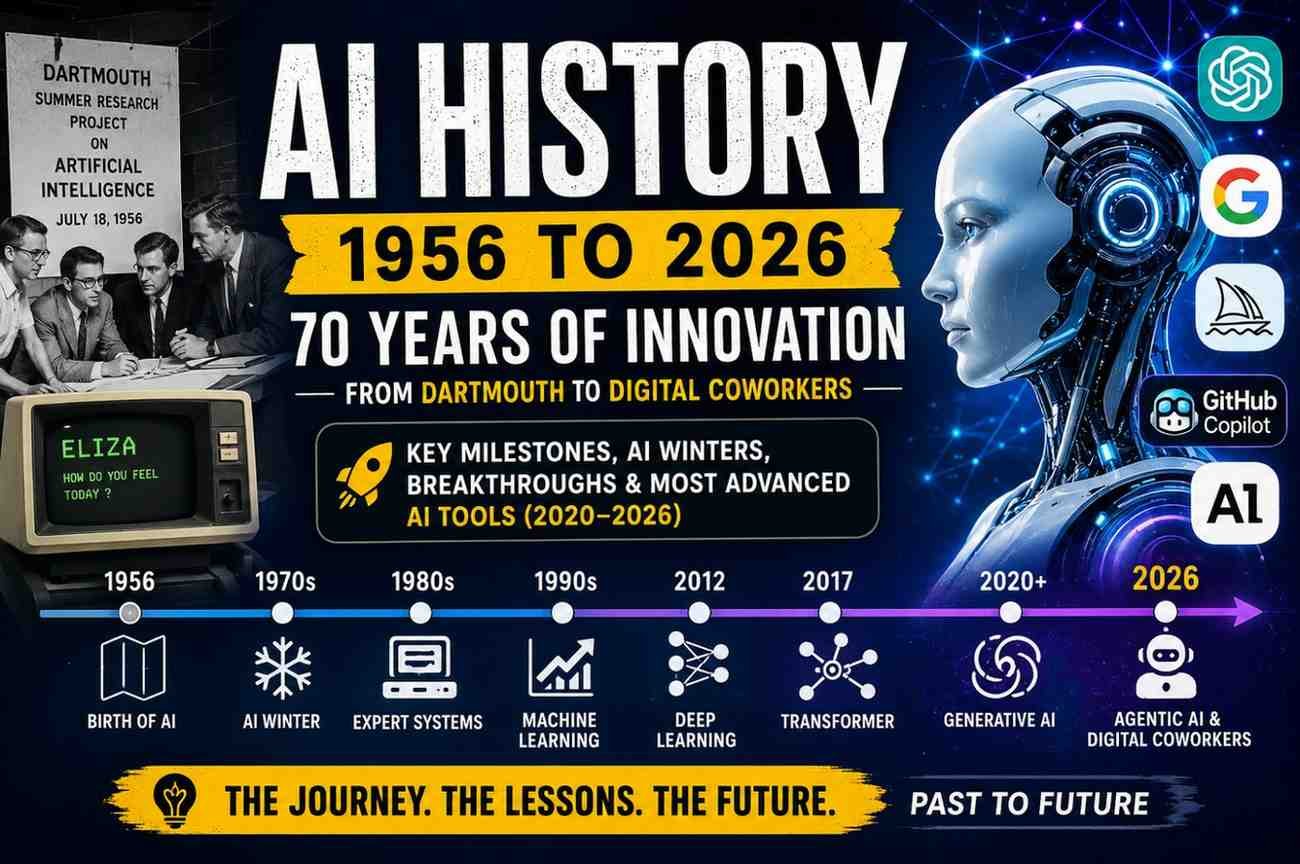
1956: The Dartmouth Conference and the Birth of AI
In summer 1956, a small workshop happened at Dartmouth College, New Hampshire, United States.
John McCarthy used the phrase “artificial intelligence” for the project proposal. He worked with Marvin Minsky, Claude Shannon, and Nathaniel Rochester. These people believed machines may learn, solve problems, understand language, and copy parts of human thinking.
1957–1969: Perceptrons, Symbolic AI and Early Optimism
Frank Rosenblatt built the perceptron, an early learning machine, during the late 1950s. It tried learning simple patterns from examples. You show something, machine checks it, then changes its answer little by little. This small idea later helped the growth of today’s computer vision systems.
Another path was symbolic AI. Here, people gave computers rules and logic. Like, “If this happens, do that.” It worked for small problems, but real world not always follow clean rules.
Arthur Samuel made a checkers program that improved through practice. His 1959 research helped make the words “machine learning” known.
In 1966, Joseph Weizenbaum created ELIZA at MIT. It matched words and replied like conversation, though it did not truly understand you.
Shakey the Robot also started in 1966 at SRI. It could see simple surroundings, plan routes and move objects.
1970–1993: AI Winters, Broken Promises and Important Lessons
During the 1970s, artificial intelligence entered a cold and difficult time. Researchers had promised too much. Computers were weak, memory was small, and useful data was not ready. Many systems worked only inside a tiny test room. Put one new problem before them, they become confused.
Governments and companies slowly stopped giving money. This period became known as the first AI winter.
In the 1980s, expert systems became popular. These programs used thousands of written rules made by human experts. Banks, hospitals, and companies tested them. At first, results looked exciting. But adding and fixing rules cost much time. The systems could not learn by themselves. Special computers were also very costly.
By the late 1980s and early 1990s, many expert systems failed to grow. Funding dropped again, creating the second AI winter.
The lesson was painful but useful. We learned machines needed stronger computers, more data, and methods that can learn patterns. These failures later pushed research from fixed human rules toward data-based learning.
1994–2011: Machine Learning Replaces Handwritten Rules
In 1995, Corinna Cortes and Vladimir Vapnik published important work about support-vector networks. These methods helped computers separate one type of data from another.
A big public moment came on May 11, 1997. IBM Deep Blue defeated world chess champion Garry Kasparov in a six-game match. Deep Blue could check around 200 million chess positions each second.
Internet also became full of useful data. Emails, searches, purchases, clicks. Companies started using patterns for:
- Spam filtering
- Product suggestions
- Credit-risk checking
- Fraud alerts
- Search ranking
- Speech recognition
You see recommendation today and think it knows you. Not fully. It only studies people actions, including yours.
In 2009, ImageNet appeared through work led by Fei-Fei Li. It gave researchers a very large labeled image collection.
2012–2016: The Deep-Learning Breakthrough
Alex Krizhevsky, Ilya Sutskever, and Geoffrey Hinton built AlexNet. It entered ImageNet contest and got 15.3% top-five error, while second team had 26.2%. That difference was huge.
ImageNet mattered because machine needed many labeled pictures for learning. Not ten photos. Millions kind of images, grouped into objects. It became practice ground where researchers can test if their systems truly seeing better.
These chips were mainly made for game pictures, but researchers used them for heavy number work. Training became faster.
Then words also changed. In 2013, Google researchers introduced Word2Vec methods, helping systems place related words closer in mathematical space.
And March 2016 came. Google DeepMind’s AlphaGo beat South Korean champion Lee Sedol 4–1 in Seoul. Over 200 million people watched.
2017–2019: Transformers Rewrite the Future of AI
In June 2017, eight Google researchers published “Attention Is All You Need.” That paper introduced the transformer architecture.
Older recurrent systems read words mainly one after another. Slow work. Also, early words may become weak when sentence is long. Transformer could study many words together, so training became more parallel and faster.
Think you are reading this line: “Ravi went to bank because he need money.” Your eyes quickly connect bank with money. You ignore less useful words for one moment. Attention mechanism doing something similar. It checks which words matter to each other.
Then Google researchers introduced BERT in 2018. It studied words from both left and right side, helping machines understand context better. OpenAI’s early GPT work also showed one pretrained model could learn general language, then adjust for many tasks.
2020–2022: Foundation Models and the Generative-AI Explosion
In May 2020, OpenAI showed GPT-3. It could do new language tasks from only few examples written inside the prompt. No full retraining needed for every small work.
GitHub launched Copilot technical preview on June 29, 2021. It suggested code lines and even full functions inside the editor. Developers saved time, but they also found broken logic and unsafe code. Best method was simple: take suggestion, read it, test it, then keep or delete.
Pictures also changed. OpenAI introduced DALL·E in January 2021. Midjourney’s first model became active in February 2022, and Stable Diffusion received public release on August 22, 2022.
Then ChatGPT arrived on November 30, 2022. It gave normal users a chat box, not a difficult machine-learning system.
2023–2024: Multimodal AI, AI Search and Enterprise Copilots
During 2023 and 2024, AI was not only reading words anymore. It started seeing pictures, hearing voice, checking files, and working with video too. This change was called multimodal AI.
Claude, Gemini, and newer GPT tools handled bigger files and longer chats. Perplexity made search feel like asking a person, not opening ten blue links. Microsoft Copilot entered Word, Excel, Teams, and other office work. Adobe Firefly helped designers make images. ElevenLabs created very real voice. Runway pushed video making ahead.
- Fake facts
- Weak sources
- Copyright doubt
- Private company data risk
- Biased reply
So, do not trust output like final truth. Check source. Keep human approval. Limit file access. Use trusted company data through retrieval systems. Your rules matter more than tool speed.
2025–2026: Reasoning Models, Agentic AI and Digital Coworkers
During 2025 and 2026, machines not only giving answers. Some systems started spending more time on hard problems, checking steps before final reply. They can search web, read files, use software tools and work with APIs for finishing larger jobs.
- Chatbot: You ask. It replies.
- Copilot: You work, and it helps beside you.
- Agent: You give a goal. It makes plan, uses tools and tries finishing work.
One wrong first step may create five more wrong steps. It may click bad button, use too much permission, remove useful file or misunderstand your real need. Keep approval before payment, deletion and publishing. Give small access. Check work after each big action.
Real-time voice makes talking more natural. Memory may remember your work style. On-device processing can give better privacy because some requests remain on your device.
Physical AI is more strange and exciting. Language models now connect with robots, helping them see objects, plan movement and perform multistep physical work.
Most Advanced AI Tools from 2020–2026, Category by Category
| Category | Leading tools | Primary use case | Major limitation |
|---|---|---|---|
| General assistants | ChatGPT, Claude, Gemini, Copilot, Grok | Writing, planning, questions and daily work | Can give wrong or made-up facts |
| Search and research | Perplexity, Gemini Notebook, research assistants | Finding, joining and explaining sources | Citation may not fully support answer |
| Coding | GitHub Copilot, Cursor, Replit, Claude Code | Writing, fixing and explaining code | Bad code can look very correct |
| Image creation | Midjourney, DALL·E, Stable Diffusion, Firefly | Ads, art, blog images and design ideas | Text, hands and details may fail |
| Video creation | Runway, Sora, Kling | Short clips and visual storytelling | Motion may look strange |
| Voice and music | ElevenLabs, Suno, Udio | Voice-over, songs and audio work | Rights and voice misuse concerns |
| Documents | Gamma, Canva AI, Tome | Slides, reports and quick layouts | Output may feel common |
| Automation | Zapier, Make, n8n, agent platforms | Joining apps and doing repeat work | One wrong step can affect whole flow |
| Data analysis | ChatGPT, Power BI Copilot, spreadsheet helpers | Cleaning data, charts and summaries | Results need number checking |
| Enterprise systems | Microsoft Copilot, Salesforce Einstein, ServiceNow AI | Sales, support and office workflows | Cost, access and privacy issues |
| Healthcare and science | Medical note tools, AlphaFold-style systems, drug research platforms | Documentation and scientific discovery | Expert checking is always needed |
| Robotics | Industrial robots and vision-language-action systems | Warehouses, factories and physical tasks | High cost and real-world safety risk |
For research, Google’s source-based notebook tool is useful when your work depends on PDFs, websites and your own study files. In July 2026, Google renamed NotebookLM as Gemini Notebook, so older articles may still show its previous name.
Choose by your task, not by social media noise. Try one small real job. Check accuracy. Check price, privacy, country access and export options. Then keep the tool which saves your time without creating another hidden problem.
What Went Wrong: Real AI Failures and How Users Recovered
It may create fake facts, missing sources, unsafe code, biased advice, or weak content made in bulk. I also seen people paste private office data without thinking. This is risky. An AI agent may even click, send, delete, or buy wrong thing when permissions are too open.
A known case happened in Mata v. Avianca. Lawyers submitted court cases that did not exist after using ChatGPT. On June 22, 2023, U.S. District Judge P. Kevin Castel ordered a $5,000 penalty and other corrective steps. The lesson was simple: confident text is not proof.
- Say clearly what result you need.
- Give trusted documents.
- Ask where each claim came from.
- Open and check every source.
- Test code before real use.
- Keep human review for health, money, law, and business.
- Limit tool permissions.
- Save logs and rollback plan.
From Experimental Programs to AI Coworkers
AI history is not one straight road. It moved from simple rule programs, then machine learning, deep learning, transformers, generative tools, and now agents doing many tasks. Some ideas failed badly. Money stopped. Hope also dropped. But researchers learned, fixed mistakes, and tried again.
You do not need remember every new tool name. I also stopped doing that. Better ask three things: What change created this tool? Which real problem it solve? Where it may go wrong?
This thinking saves your time. It also protect you from loud promises. New tools will come and vanish, but clear understanding stays with you.
Frequently Asked Questions About AI History
1. Who is considered the father of artificial intelligence?
John McCarthy is mostly called the father of artificial intelligence. He helped create the term “artificial intelligence” and organized the Dartmouth research project. Still, many people built this field, not one man alone.
2. Why is 1956 called the birth year of AI?
In summer 1956, scientists met at Dartmouth College in New Hampshire, United States. They discussed whether machines can learn, reason, and solve human problems. This meeting made AI a formal study field.
3. What were the first and second AI winters?
AI winters were bad periods when funding and public trust dropped. First came mainly in the 1970s. Second happened from late 1980s into early 1990s. Big promises failed because computers, data, and programs were still weak.
4. What breakthrough led to modern generative AI?
The Transformer was the main turning point. Eight researchers introduced it in the 2017 paper Attention Is All You Need. It helped machines study word connections faster and train on huge text collections.
5. Was ChatGPT the first generative-AI tool?
No. Text, image, and music generation existed earlier. GPT-3, DALL·E, Midjourney, and other systems came before it. ChatGPT became special because normal people could easily talk with it. OpenAI released it on November 30, 2022.
6. What is the difference between generative AI and agentic AI?
Generative AI makes something, like text, picture, code, or sound. Agentic AI goes more steps. It can plan work, choose tools, and perform actions. But you should watch it, because one wrong action may grow into bigger trouble.
7. Which AI tools became most influential after 2020?
ChatGPT, Claude, Gemini, GitHub Copilot, Midjourney, Stable Diffusion, Perplexity, ElevenLabs, Runway, and Microsoft Copilot became widely known. Their value is different. Pick by your real need, not online noise.
8. Has artificial general intelligence been achieved by 2026?
No widely accepted proof says AGI is achieved by August 2026. Even its meaning is debated. Google Cloud still explains AGI as hypothetical intelligence able to learn almost any human intellectual task. So, powerful tools are here. Full human-like general mind, not confirmed.
