
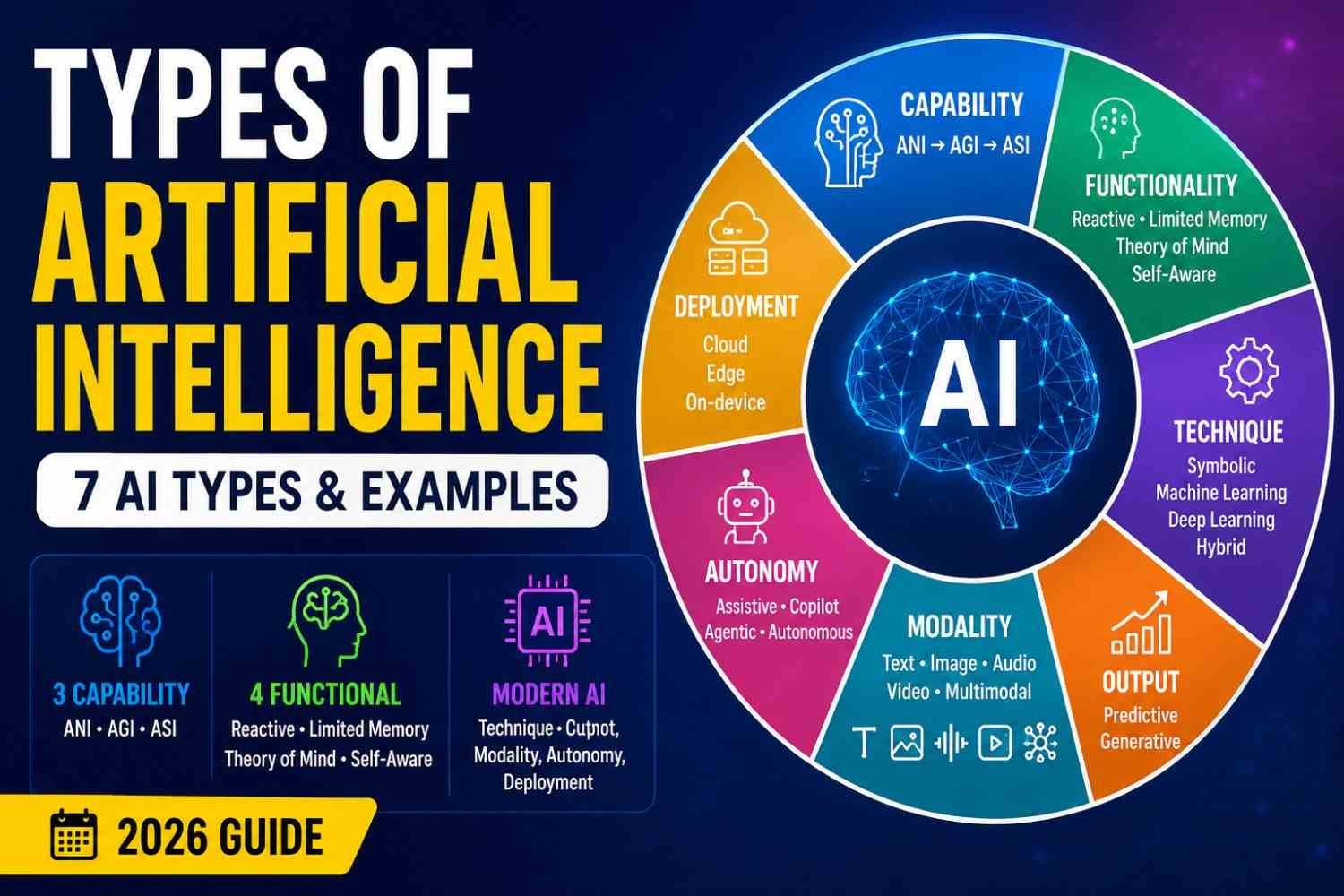
The three capability types are ANI, AGI, and ASI. The four functionality types are reactive, limited-memory, theory-of-mind, and self-aware AI.
So, how many types of AI are there? This question look simple, but answer not one fixed number.
I also got confused first time. One page says 3 types. Another says 4. Then someone says 7 types of artificial intelligence. What is going on?
The problem is, they classify AI in different ways.
3 types talk about capability.
4 types talk about how the system functions.
7 types usually put both groups together.
And modern AI goes even wider. We can classify it by technique, output, modality, autonomy, and deployment too.
So one system can sit in many groups at same time. That is the key thing to understand before going deeper.
Artificial Intelligence Types at a Glance — The Complete Classification Matrix
When I first read about types of artificial intelligence, I got stuck on one silly question: why one page says 3 types, another says 4, and some says 7? The problem is not always wrong info. We are just looking at AI from different sides.
This table make it easier.
| Classification | Types | What It Tells You |
|---|---|---|
| Capability | ANI → AGI → ASI | How broad the system can perform |
| Functionality | Reactive → Limited Memory → Theory of Mind → Self-Aware | How it uses information and reacts |
| Technique | Symbolic → ML → Deep Learning → Hybrid | How the system gets built |
| Output | Predictive → Generative | What it predicts or creates |
| Modality | Text → Image → Audio → Video → Multimodal | What kind of data it handles |
| Autonomy | Assistive → Copilot → Agentic → Autonomous | How much work it can do alone |
| Deployment | Cloud → Edge → Embedded/On-device | Where the system runs |
Here is the part people often miss. One system can appear in several columns.
A modern assistant, for example, can be narrow AI, built with deep learning, generate new content, understand text and images, use tools like an agent, and still run mainly from cloud servers.
So when you ask, “What type of AI is this?” first ask, type based on what?
The 3 Types of AI Based on Capability
When we sort types of artificial intelligence by capability, three names come up: ANI, AGI, and ASI. But they are not three things you can go and use today. That part matters. Current systems sit mainly in the narrow-AI side, while AGI and ASI remain theoretical concepts.
1. Artificial Narrow Intelligence (ANI)
Artificial Narrow Intelligence, also called weak AI, is built for a limited task or group of tasks. Narrow does not mean useless or small. I think this word confuses people badly. A system can beat us in one job and still not understand another job at all.
Recommendation engines, fraud detection, image recognition, search ranking, voice tools, and language models fit this practical world of ANI. IBM also classifies current systems, including ChatGPT, under narrow AI rather than AGI.
So when you ask, “What type of AI exists today?”, ANI is the safest broad answer. Being very powerful inside one field does not suddenly make software generally intelligent.
2. Artificial General Intelligence (AGI)
AGI means something much wider. It would learn, reason, adapt, and carry knowledge into unfamiliar problems across many fields, closer to the breadth humans show.
This is where the ANI vs AGI difference becomes useful. ANI may do many trained tasks. AGI should handle new kinds of problems with much broader independence.
Does AGI exist? There is still no agreed scientific proof that it does, and even researchers do not fully agree on the exact test for AGI. Advanced LLM skill alone is therefore not enough to call something AGI.
3. Artificial Superintelligence (ASI)
Artificial Superintelligence goes another step. ASI means a hypothetical system whose broad intellectual ability exceeds human ability, not merely a machine doing calculations faster.
That difference is easy to miss. A chess engine beating every human at chess is still specialist strength.
ASI has not been demonstrated in the real world. It remains a future concept, and even its feasibility is debated.
Simple way I keep it: ANI is here. AGI is unproven. ASI is hypothetical.
The 4 Types of AI Based on Functionality
When people ask what are the 4 types of AI, they usually mean how a system works with information, memory, and maybe one day, human feelings. This is different from ANI, AGI, and ASI. Those talk about capability. Here, we look more at how the system behaves.
1. Reactive Machines
Reactive machines are the simplest form. They look at what is happening now, then make a response. No useful past experience carried forward.
IBM Deep Blue is the old example I always remember. It beat chess champion Garry Kasparov in 1997. Deep Blue checked the board position and possible moves, but it did not sit later and “remember the pain” of a bad move like we humans do.
So, reactive AI meaning is quite simple: input comes, machine reacts.
2. Limited-Memory AI
Now things become little more practical.
Limited memory AI can use past or recent information while making a decision. Many modern machine-learning systems work in this kind of way. A vehicle may watch nearby cars for some time. A chatbot may use earlier words in your conversation. That context can change what comes next.
But one mistake I see often: people think model training, chat context, saved app memory, and human memory are same. They are not.
A model may learn patterns during training. A context window may keep recent text. An application may save your preferences in database. Human autobiographical memory is another thing again.
That difference matters when comparing reactive vs limited memory AI.
3. Theory-of-Mind AI
This part becomes harder.
Theory-of-mind AI would not only read your words. It would build some model of what you believe, want, feel, or intend, then change its behavior from that understanding.
Research systems and large language models can sometimes perform surprisingly well on Theory-of-Mind style tests. But passing such tests does not prove that a machine truly understands another person’s mind. Researchers still debate what those results really show.
So when somebody asks, does theory of mind AI exist, I would be careful. Pieces of this behavior exist in research. Full human-like Theory of Mind is a much bigger claim.
4. Self-Aware AI
Then comes self-aware AI, the most speculative one.
This would mean a system has awareness of its own internal existence, not only saying sentences like, “I think” or “I feel.”
That language can fool us easily. A model can generate self-looking words without having subjective experience behind them.
Current consciousness research warns about both wrongly giving consciousness to machines and wrongly ruling it out without proper tests. There is still major scientific uncertainty. One 2025 study looking inside LLM representations found no strong evidence of consciousness.
So, are any AI systems self-aware today? We do not have accepted scientific proof of that. Self-aware AI remains theoretical, and good discussion should keep that line very clear.
Why People Call These the “7 Types of Artificial Intelligence”
You searched “What are the 7 types of artificial intelligence?” I did same before writing this. Funny thing happened. One website showed 3 types. Another showed 4. Then another proudly said 7. I got confused for a minute. Maybe you also feel same.
Truth is simple. Seven types are not one official AI ladder. They come from two different ways of classifying AI. One explains how powerful AI can become. The other explains how AI behaves and uses information.
The popular 7 AI types
|
Group
|
Type
|
| — | — |
|
Capability
|
- Artificial Narrow Intelligence (ANI)
|
| |
- Artificial General Intelligence (AGI)
|
| |
- Artificial Superintelligence (ASI)
|
|
Functionality
|
- Reactive Machines
|
| |
- Limited Memory
|
| |
- Theory of Mind
|
| |
- Self-Aware AI
|
Here is the important part. ANI does not become Reactive. AGI does not become Theory of Mind. These are not seven steps of evolution. They are two separate maps looking at the same field from different angles.
When you understand this, almost every confusing types of AI article suddenly starts making sense.
Modern AI Types — A Better Way to Classify AI in 2026
The old 3, 4, or 7 types of AI list help, but only little. I used to look at those lists and still ask, “Okay, but where this actual tool fit?” That is the problem.
Modern systems need more than one label.
You can ask five simple things:
- How is it built? → Technique
- What does it make? → Output
- What can it understand? → Modality
- How much work can it do alone? → Autonomy
- Where does it run? → Deployment
This make classification more useful in real work.
Take an AI coding assistant. It may still be narrow AI, because its job area is limited. Under the hood, it may use deep learning. Its output is generative, because it writes code. Its modality may be text and code. Some tools only suggest next lines, like a copilot. Others can open files, run commands, test code, then fix errors. That become more agentic.
And deployment also changes things. Some coding tools run mainly through cloud servers. Other models can run locally on your laptop.
So one system can sit inside many AI types together. That is why modern AI classification works better like a map, not one straight list.
Types of AI by Technique — Symbolic AI, Machine Learning, Deep Learning & Hybrid AI
AI can be grouped by how the intelligence is created. This part confused me before. I was mixing machine learning with ANI and AGI. They are not same type of grouping. ANI, AGI and ASI talk about capability. Machine learning and deep learning talk about technique.
Symbolic AI
Symbolic AI works with rules, logic and stored knowledge. You can think like old expert systems. If this happens, do that. It can be clear and easy to inspect. But real world becomes messy fast. Rules keep growing, then maintaining them become hard.
Machine Learning
Machine learning learns patterns from data instead of writing every rule by hand. We have supervised learning, unsupervised learning, reinforcement learning and self-supervised learning. A spam filter, recommendation system or fraud model may use these methods.
Deep Learning
Deep learning is part of machine learning. It uses neural networks with many layers. This technique pushed computer vision, speech systems and modern language models much further. Transformers, LLMs and many foundation models sit around this world.
Hybrid AI
Hybrid AI mixes methods. I like this idea because one method rarely solve everything. A system may use a neural model, rules, search, tools and a knowledge base together.
So when you ask types of artificial intelligence by technique, think about how the system is built, not how smart it may become.
Predictive AI vs Generative AI — Types Based on Output
Predictive AI and generative AI look close, but they do different job.
Predictive AI looks at old patterns and says what may happen next. You may see it in a fraud score, demand forecast, churn prediction, credit risk check, or product recommendation. It mostly gives a class, score, chance, or forecast.
Generative AI does another thing. It makes new output from patterns it learned before. Text, image, code, audio, video, even structured data.
I think this difference become easy when you ask one small question:
“Is the system predicting something, or making something?”
| Type | Main Output | Example |
|---|---|---|
| Predictive AI | Score, class, forecast | Fraud risk |
| Generative AI | New content | LLM answer, image, code |
One confusion I see much. Generative AI is not some “eighth type of AI” after the famous seven. It sits on another classification line: type based on output.
So in predictive AI vs generative AI, neither one replace the other. Many real systems now use both together.
Types of AI by Modality — Text, Image, Audio, Video & Multimodal AI
You can also group types of AI models by what kind of information they take in, and what they send back.
Text AI works with words. Documents, chats, emails, code, search questions. I use this kind most when I want something explained or rewritten fast.
Image AI looks at pictures. It may find objects, read visual details, create new images, or edit an old one.
Audio AI handles sound. Speech-to-text, voice making, music study, noise finding. Useful, but accents and bad audio still can make trouble.
Video AI goes further. It must understand frames over time, movement, actions, and sometimes create new video too.
Then comes multimodal AI. This one can mix text + image + audio + video in one system.
A simple doubt here: generative AI vs multimodal AI are not same. Generative tells what system creates. Multimodal tells what forms it can understand or produce. So one tool can be both.
Assistive, Copilot, Agentic & Autonomous AI — Types Based on Autonomy
Not every AI should work alone. This part matter a lot.
Assistive AI waits for you. You ask something, it answers, checks, explains, or finds a pattern. It does not usually move ahead by itself. You are still driving.
Copilot AI sits little closer to your work. It may suggest code, write a draft, find an error, or recommend the next step. You decide what to accept. I like this model in risky work because human still stays in the loop.
Then comes agentic AI. This is where things become more active. You give a goal, not every tiny step. The system can plan, use tools, keep memory or state, check results, and try another action. This is why people search AI agents vs generative AI. Generative AI mainly creates an output. An agent can continue doing work around that output.
But agentic AI is not AGI. A narrow model can still look very smart when software gives it tools, memory, rules, and workflows.
Autonomous AI goes further. It can act with less human touch inside set limits.
More freedom also brings more risk. So we need permission limits, approval gates, logs, stop rules, and rollback plans. Without these, one small wrong action can travel too far.
Cloud AI vs Edge AI vs On-Device AI
Where your AI runs, it change many things. Speed, privacy, cost, even whether it work when internet gone.
Cloud AI runs on remote data centers. Big models fit there because servers have strong compute. You send data out, result comes back. Good power, but internet and delay can become pain.
Edge AI moves processing near the place where data happen. A factory camera, shop system, or local gateway can decide faster. Less data need travel, so bandwidth use also drop.
Then we have on-device AI. Model runs inside your phone, laptop, car, or sensor itself. I like this when privacy or offline work matter. But device memory, battery, and chip power put limits.
So, edge AI vs cloud AI is not one winner. You choose where your real problem fits.
Which Type of AI Is ChatGPT?
Calling ChatGPT only generative AI feels easy, but not fully right. I used to do same. Then problem comes: one system can sit in many AI types at once.
Here is simpler way to see it:
| View | ChatGPT fits here |
|---|---|
| Capability | Narrow or specialized AI |
| Technique | Deep learning + foundation models |
| Output | Generative AI |
| Modality | Text, and multimodal in supported experiences |
| Autonomy | Assistant/copilot; can become agentic with tools |
| Deployment | Mainly cloud based |
So, is ChatGPT narrow AI? Under normal AI taxonomy, yes. Is ChatGPT AGI? We should not jump there just because conversation feels human.
This part matters. A machine can write, reason, browse, use tools, even work across longer workflows, yet that still does not prove consciousness or self-awareness. OpenAI itself describes newer ChatGPT workflows as able to use tools and perform multi-step work, but these remain designed systems with controls and defined access.
Real-World Types of AI by Industry
AI types look easy in a chart. Real life is more messy.
You open a banking app. Fraud system checks strange payment. Then support bot answer your question. Two different jobs, maybe two different AI classifications working inside same app.
| Industry | AI Examples | AI Classification |
|---|---|---|
| Healthcare | Imaging, notes, prediction | Vision + predictive/generative |
| Banking | Fraud checks, risk models | Predictive ML |
| Ecommerce | Recommendations, search, assistants | ML + generative AI |
| Education | Tutors, feedback tools | Generative/conversational AI |
| Manufacturing | Defect checks, maintenance warning | Vision + predictive AI |
| Software | Coding assistants, agents | Generative + agentic AI |
| Transport | Perception, planning, control | Vision + autonomous systems |
Healthcare show this clearly. One system may inspect an image, another predict risk, another help write clinical notes. We should not call all of them simply “healthcare AI.”
Same thing in ecommerce. Your product suggestion may come from machine learning, while the shopping assistant use generative AI.
This is why real-world types of AI overlap. One product can use vision, prediction, generation, and automation together. Classification help us understand each part, not force whole product into one box.
Common AI Classification Mistakes
I see this mistake again and again. People put AI, machine learning, and deep learning like all are same thing. They not. AI is bigger field. Machine learning sits inside it, and deep learning is one method inside machine learning.
Another confusion, generative AI is not automatically AGI. It can write good text, make image, even code. Still that not mean human-level general mind.
Same with agentic AI. Using tools and doing steps alone does not make it fully autonomous or generally intelligent.
You may also see multimodal AI and generative AI in one system. Both labels can fit.
Fluent chatbot talk does not prove consciousness. “Limited memory” also not mean your account memory.
And those famous seven AI types? They are not seven fixed evolution steps. One system can sit inside many AI classification groups at same time.
How to Identify What Type of AI You Are Using
I usually don’t trust one label like “smart AI” or “advanced AI.” That tells me almost nothing. Better, you check it from seven small angles.
Ask this:
- Capability: Is it doing one special job, or many very different jobs?
- Functionality: Does it only react now, or use past/context data too?
- Technique: Is it rules, machine learning, deep learning, or mixed?
- Output: Is it predicting something, or creating new content?
- Modality: Text, image, audio, video, or many together?
- Autonomy: Is it an assistant, copilot, agent, or mostly working alone?
- Deployment: Is it running in cloud, edge system, or your own device?
This method helps much more than forcing one product into one box. Your chatbot, for example, may be narrow, generative, multimodal, cloud-based, and also agent-like at same time.
FAQ
What are the 4 types of AI?
The 4 types of AI are Reactive Machines, Limited Memory, Theory of Mind, and Self-Aware AI. Reactive systems work from what is happening now. Limited-memory systems can use some past or context data. Theory-of-Mind AI would understand human thoughts and feelings better. Self-aware AI would understand its own state too, but this one still theoretical.
What are the 3 main types of artificial intelligence?
By capability, we normally talk about ANI, AGI, and ASI. ANI means narrow intelligence made for certain jobs. AGI means human-like general ability across many tasks. ASI means intelligence beyond humans. Today, ANI is the real working category; AGI and ASI remain theoretical.
What are the 7 types of artificial intelligence?
You may see 7 types of artificial intelligence online because people join two lists together: 3 capability types + 4 functional types. It is useful for learning, but they are not seven steps in one straight line.
Which type of AI is most common today?
Narrow AI or ANI is what we mostly use today. Search tools, recommendation systems, language models, image systems and many business tools fit here.
Does AGI exist today?
No accepted AGI system exists today. Even there is debate about what exact test would prove AGI. Current LLMs can do many things, but IBM’s July 2026 update says they are not considered AGI.
Is generative AI a type of artificial intelligence?
Yes. But here is where I once got confused too. Generative AI describes what a system produces—text, images, code, video and more. It is not another capability level after ANI, AGI and ASI.
Is agentic AI the same as AGI?
No. An AI agent can plan, use tools and complete several steps, yet still use narrow models underneath. More action does not automatically mean general intelligence.
Can one AI belong to several types?
Yes, very often. One system can be narrow, limited-memory, generative, multimodal, cloud-based and agentic at same time. This is why asking “which type?” needs one more question: type based on what?
Conclusion — Stop Asking for One Number of AI Types
People keep asking, how many types of artificial intelligence are there? I did same before. But one number make more confusion.
Three types tell about capability: ANI, AGI, ASI. Four types tell how system work: Reactive, Limited Memory, Theory of Mind, Self-Aware.
Then modern AI needs more boxes. Technique tells how it built. Output tells what it predicts or creates. Modality tells what kind of data it can understand. Autonomy tells how much it can act alone. Deployment tells where it runs.
So when you see “7 types of AI,” don’t stop there. Ask one better question:
Which classification dimension are we talking about?
Read Next: How does AI works?
