
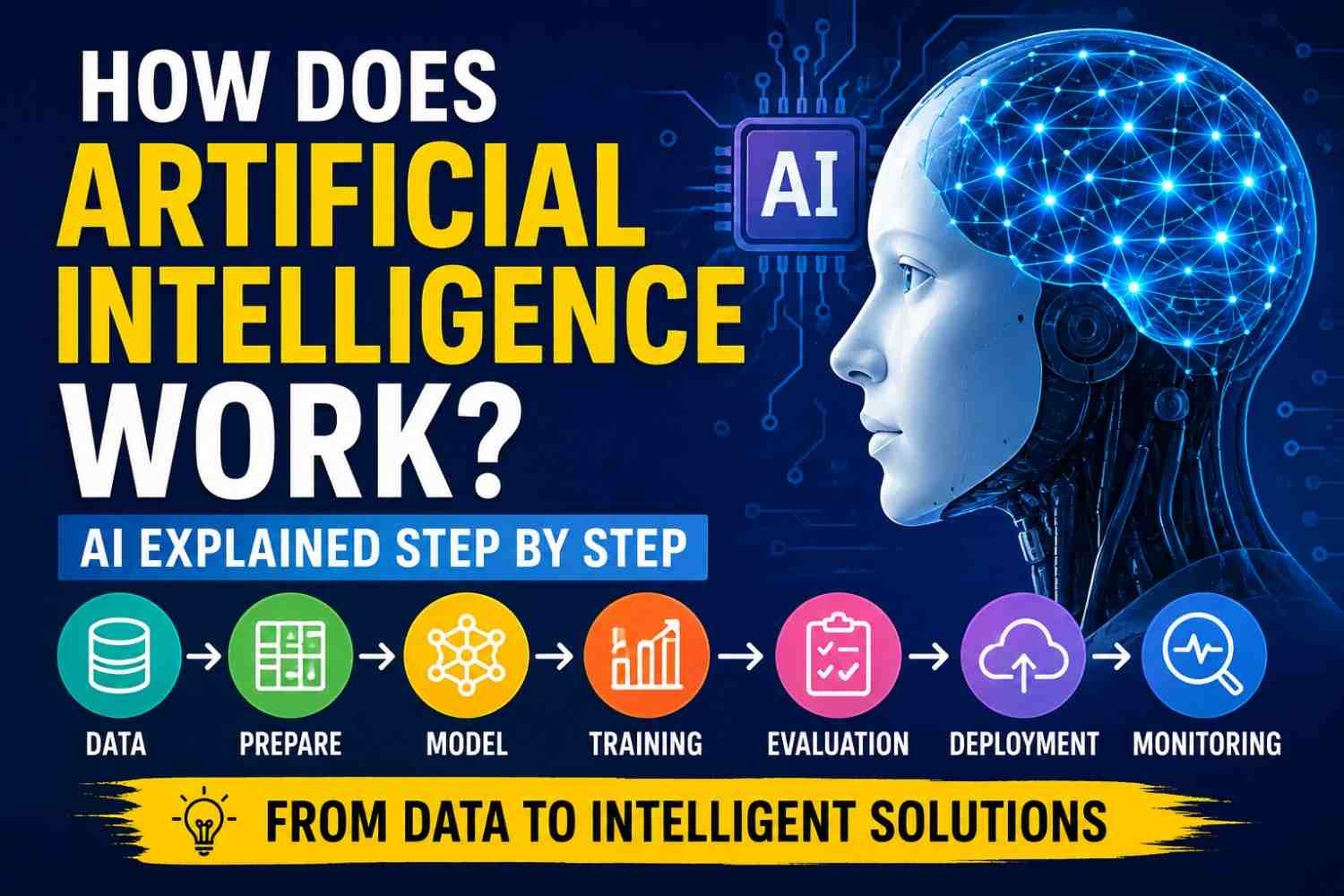
Artificial intelligence works by taking data, finding useful patterns, and using those patterns to handle new input. During training, a machine-learning model changes many small number settings called parameters. Later, during inference, the trained model uses what it learned to make a prediction, answer, recommendation, or action.
Think simple:
Data → Patterns → Model → New Input → Prediction/Output
Your input can be text, photo, voice, numbers, bank transactions, or sensor data. The algorithm helps the system learn from examples.
I used to think AI got answers from one giant stored database. It is not that simple. A trained model can face something new and calculate a likely output from patterns it learned before.
That output may be a spam warning, movie recommendation, image, classification, generated answer, or another action.
And one important thing: different AI systems learn and work in different ways.
AI vs Normal Computer Programming — What Is Actually Different?
This part confuse many people. Maybe you also. I was confused too some years back. We see computer doing smart things, then mind ask one question. If computers only follow instructions, then how AI learn?
Look at this simple table.
| Traditional Programming | Machine Learning |
|---|---|
| Rules + Data → Answer | Data + Examples → Learned Model |
In normal software, developer write rules first. Computer follow them. Nothing more. If rule says do this, it do this. If rule missing, computer stuck.
Example. A calculator. You press 5 + 5. It gives 10 because somebody already wrote that rule.
Machine learning little different. We give many examples instead of writing every rule by hand. System search patterns inside data. After training:
Trained Model + New Data → Prediction
Many people think every response is manually programmed. Not really. Developers build the system, collect data, choose algorithms, create goals, test results, and maintain infrastructure. But they usually do not write millions of tiny decision rules one by one.
Another thing. AI is not magic. No data, no examples, no objective, no learning.
Also not every AI system uses machine learning. Some rule-based expert systems still belong under the big AI umbrella.
So is AI just normal software with a new name? Not exactly. It is still software. But instead of only following fixed rules, some systems learn useful patterns from examples and use those patterns to make predictions.
How Artificial Intelligence Works Step by Step
When people ask how artificial intelligence works, the answer can get messy very fast. Neural networks, vectors, training data, models. Too many words come before we even see what is really happening.
So I like one small example.
We want to teach a computer one job:
Look at an animal photo and tell us: cat or dog?
Nothing more for now.
That small problem shows almost the full AI learning process.
Step 1 — Define the Problem
Before collecting thousands of pictures, first decide what the machine should actually do.
Our input is simple:
Input → animal photo
Our wanted result is also simple:
Output → cat or dog
This kind of task is called classification because the system places an input into a class.
Other AI jobs can be different. A system may predict tomorrow’s demand, rank search results, detect fraud, or generate text. But the question should be clear before training starts.
I have seen this part get skipped. Then later everything becomes confusing. If we cannot explain the job in one clean sentence, our data may also go in wrong direction.
For our example:
“Given one animal image, predict whether it contains a cat or a dog.”
Now we know what we are building.
Step 2 — Collect Training Data
Next we need examples.
A computer does not wake up already knowing a fluffy orange thing is a cat. We need to give it enough useful examples so patterns can be learned.
So we collect many cat photos and dog photos.
Each image can have a label:
- Cat photo →
cat - Dog photo →
dog
This is called labeled training data. In supervised machine learning, labels act like the known answer connected with each example. IBM describes labeled datasets in the same way: inputs are paired with labels so a model can learn relationships between them.
But here one problem comes.
More pictures does not always mean better learning.
Imagine we collect 10,000 cat images taken inside bright homes, but nearly every dog image comes from dark outdoor photos. The model may learn a bad shortcut: bright room means cat, dark place means dog.
Technically it got patterns. But not the pattern we wanted.
Wrong labels hurt too. If many dog photos are marked as cats, we are teaching with wrong answers. IBM notes that incorrect or inconsistent annotations can lead a model toward false predictions.
So when you ask, where does AI training data come from?, answer can be many places: cameras, sensors, company records, public datasets, documents, user activity, manually collected examples, and other approved sources.
Quality matters. Variety matters. Correct labels matter.
I would check the dataset before touching the model.
Are both cats and dogs represented well? Are broken files hiding there? Are duplicate photos everywhere? Are labels actually right? It feels boring compared with “building AI,” but this boring work can decide whether the system works later.
Step 3 — Prepare the Data
Now we have photos. Still, we normally cannot throw messy raw files directly into training and hope for magic.
We prepare them first.
For our cat and dog example, images may come in many sizes. One photo is tiny. Another is huge. Some files may be broken. A few may have strange formats.
So preprocessing can include:
- resize images to a common shape,
- remove damaged files,
- fix wrong labels,
- normalize numerical values,
- handle missing records,
- convert data into the form expected by the model.
Raw data is often not ready for machine learning, and preprocessing is used to clean and transform it before training.
The same idea happens with other data.
For text, we may clean the text and break it into tokens.
For numbers, we may scale values so wildly different ranges do not create needless trouble.
For words and other items, systems can turn information into numerical forms such as vectors or embeddings. Text classifiers, for example, need machine-readable numerical representations rather than raw language alone.
That point is important.
Your computer sees a cute cat.
The model does not sit there thinking, “Oh nice whiskers.”
It receives numbers.
Pixels become numerical values. Words can become tokens and vectors. Useful parts of data become features or learned representations that the model can process.
This is where the problem starts becoming mathematics underneath, even though we do not need heavy math to understand the idea.
We began with one ordinary photo.
After preparation, we now have clean, usable numerical input ready for the next part: choosing a model and letting it make its first very bad predictions.
Step 4 — Choose a Model
Now our data is ready, but it still need something that can learn from it. This is where we choose a model.
A model is like a math structure where patterns can get stored during training. Different problems need different ones. Regression may predict a number. Decision trees make choices through branches. Neural networks handle harder patterns like images. Transformers are widely used for language.
One thing confused me first: algorithm and model are not same.
An algorithm is the method used to learn. The trained model is what remains after learning, with its adjusted parameters inside.
Step 5 — The Model Makes Predictions and Measures Its Error
First prediction can be very bad. That is normal.
Say we show one cat photo.
Real answer: Cat
Model prediction: 30% cat, 70% dog
Clearly, it got this one wrong. But how does AI know it made a mistake?
During training, the predicted result gets compared with the answer we already know. A loss function turns this difference into a number. You can think of loss as a small score saying, “How wrong were you?”
Higher loss usually means prediction was poor. Lower loss means it came closer.
That error is useful. Without seeing its error, the model has no direction for improving. So a wrong prediction is not just failure here. It becomes the signal used for the next learning move.
Step 6 — Training Changes the Model
This part once looked like magic to me. It is mostly repeated math.
Inside a model are many adjustable numbers called parameters. In neural networks, many of these are called weights. A weight can affect how strongly one learned signal matters when making a prediction.
The learning cycle looks roughly like this:
Prediction → Error → Calculate useful changes → Adjust parameters → Try again
Backpropagation helps calculate which weights contributed to the error. Then an optimization method, often gradient descent, moves those values in a direction that may reduce the loss.
But we cannot change them too wildly. The learning rate controls roughly how large each update should be. Too large, training may jump around. Too small, learning may become painfully slow.
Data is normally processed in smaller groups called batches. When the model has worked through the whole training set once, that is called an epoch.
Then again. And again.
So what does AI actually learn? Not readable rules like “cats have ears.” It learns numerical relationships inside its parameters. Large models may contain billions of such values, each playing a small part in shaping the final output.
Step 7 — Test the Model on New Data
A model doing great on its homework does not mean it understood the lesson.
We normally separate data into training, validation, and test data. Training data helps it learn. Validation data helps us tune choices. Test data checks performance on examples kept away from training.
This matters because a model may simply memorize old examples. That problem is called overfitting.
What we really want is generalization: it sees a fresh cat photo it never trained on, yet still says, “cat.”
That unseen test is where the useful learning becomes clear.
Step 8 — Deploy the AI and Run Inference
After testing looks good enough, the trained model can go into a real app, website, phone, server, or other system.
Now the flow becomes simple:
New input → Trained model → Output
This stage is called inference. Inference means using an already trained model to handle new information.
A new animal photo comes in, it predicts cat. A bank transaction comes in, it may flag possible fraud. A streaming app may recommend a movie. You type a prompt, a language model produces an answer.
Training was where the model learned its parameters. Inference is where we finally put that learning to work.
Where Machine Learning, Deep Learning and Neural Networks Fit Into AI
These words confused me first time. AI, machine learning, deep learning, neural network. People use them like all same thing. They are not.
Think like a family tree:
Artificial Intelligence
↓
Machine Learning
↓
Deep Learning
↓
Neural Networks / Modern Architectures
Artificial intelligence (AI) is the big field. It means making computers do tasks which look smart, like understand text, find objects in photos, recommend videos, or solve problems.
Machine learning sits inside AI. Here, we don’t write every rule by hand. We give data, and system learns useful patterns from it.
Then comes deep learning. It is a part of machine learning which mainly uses neural networks with many processing layers. A neural network is one method of machine learning; deep learning usually means using larger, multi-layer neural networks.
Learning also happens different ways:
- Supervised learning: Give photos marked “cat” and “dog.” Model learns from correct labels.
- Unsupervised learning: Give customer data without labels. System may find similar customer groups itself.
- Self-supervised learning: Hide part of text and make model predict missing parts. This idea helps train many language models.
- Reinforcement learning: System tries actions and gets rewards or penalties, like learning which move works better in a game.
And generative AI? It often uses deep-learning models to make new text, images, audio, code, and more.
So don’t mix the boxes. AI is big umbrella. Machine learning lives under it. Deep learning goes deeper inside. Neural networks are the machinery often doing that deep work.
How Does a Neural Network Learn?
A neural network learns by making a guess, seeing how wrong that guess was, then changing tiny number values inside itself. It do this again, again, many times. Sounds simple. Inside, lot is happening.
Think about an AI learning cat photos.
First comes the input layer. Your photo enters as numbers. Not really as “cute cat.” Computer don’t see cute. It gets pixel values.
Then information moves through hidden layers. These layers start finding clues like:
- edges and curves
- shape
- texture
- small patterns
An artificial neuron is basically a small math unit. It receives input values and gives them different importance using weights. A weight can make one clue matter more, another less. A bias gives another small adjustment. Then an activation function decides how strongly that neuron should pass information forward.
After many hidden layers, we reach the output layer.
Maybe result says:
Cat: 82%
Dog: 18%
This first movement from input to answer is called a forward pass.
But during early training, answer may be bad. I always found this part useful to remember: wrong answer is not useless here. Wrong answer is actually where learning starts.
The system calculates loss, meaning roughly, “How wrong was my prediction?”
Then comes backpropagation. It works backward through network and finds which weights helped create that error. An optimizer then makes small weight updates.
So the loop becomes:
Forward pass → Prediction → Loss → Backpropagation → Weight update
Do this across lots of examples, and hidden layers gradually build useful representations.
One thing worth clearing. Neural networks got loose inspiration from biological neurons, but they are not tiny human brains sitting inside computer. They are mathematical systems.
So, does AI learn like us? Not really. We understand life through senses, memory, body, experience. A neural network mostly learns by adjusting numbers until its predictions become better.
How Does Generative AI Work?
Generative AI work little different from old prediction systems.
A normal predictive system may ask, “Is this photo a cat or dog?” Then it choose one class. Generative AI ask another kind question: “Can you make a new image from this text?” Now the job is creating, not only sorting.
It can make:
- text,
- images,
- computer code,
- audio,
- video.
The basic path look like this:
Training data → learned patterns → your prompt → model calculation → new output
During training, the model sees huge amount of examples. It does not usually keep one ready answer somewhere and paste it later. Instead, neural networks learn patterns, structure, links, style, and relationships inside the data. NVIDIA describes generative models this same basic way: neural networks identify patterns in existing data and then use those learned structures to generate new content.
This is where foundation models come. They are large pre-trained models made to support many tasks. An LLM is one type, mainly built around text and code. Other foundation models can work with images, audio, video, or several types together. Google calls these multimodal models when one model can handle more than one form of information.
Suppose you type, “Write a small story about a farmer on Mars.” The system does not need that exact story stored before. It uses learned relationships and calculates what content should come next.
Text models may generate token by token. Image systems use different generation methods to build visual patterns from your prompt.
So where does generative AI get “ideas”?
Not ideas like our human mind. It recombines learned patterns under your instruction. Sometimes result feels totally new. That is the strange part. You see something never written exactly before, but its building knowledge came from patterns learned earlier.
How Does ChatGPT and an LLM Work After You Press Enter?
You type a question and hit Enter. Response comes fast, so it can feel like ChatGPT already had that answer sitting somewhere. It mostly does not work that simple.
The rough path looks like this:
Prompt → Tokens → Embeddings → Transformer → Context/Attention → Token Probabilities → Selected Token → Repeat → Response
Your Prompt Becomes Tokens
First, your sentence gets broken into tokens. A token may be one word, part of a word, punctuation, or another small text piece.
So your nice human sentence becomes smaller machine-readable units. This is called tokenization.
Tokens Become Numerical Representations
Computers cannot work with meaning like we do. They work with numbers.
Each token gets changed into a numerical representation called an embedding. You can imagine it like coordinates inside a huge math space. Words or ideas used in similar ways may get useful relationships there.
I found this strange first time. The model is not seeing “dog” like a picture of dog in our head. It is handling numbers that carry learned relationships.
Transformer Layers Process Context
Now those token representations move through many transformer layers.
A key part is self-attention. It helps the model look at relationships between different tokens in your current context.
Take:
“Ravi put the glass on the table because it was wet.”
The model has to work out what “it” may refer to. Attention helps connect those pieces instead of reading every word alone.
This usable amount of text around the current request is often called the context window.
The Model Predicts the Next Token
Then comes the part many people miss. An LLM produces probabilities for what token may come next.
For:
“The capital of France is ___”
Paris may receive high probability. London lower. Tokyo much lower.
One token gets selected, then the process runs again. And again. Token after token until you receive the answer.
This also helps explain why the same prompt can sometimes produce different wording.
ChatGPT Is More Than a Raw Language Model
ChatGPT can also have systems around the model: instructions, safety checks, memory, retrieval, web search, tools, databases, code execution, and other app logic.
So, is ChatGPT always searching Google? No. It can search the web when that capability is used, but normal model generation does not automatically mean web searching.
And no, every chat does not simply rewrite the model instantly. OpenAI provides separate controls for whether conversations may help improve models, while ChatGPT memory is also a separate feature you can manage.
That difference matters. Conversation context, saved memory, and model training are not the same thing.
AI Training vs AI Inference
I used to mix these two things also. Training and inference sound almost same when you first learn how artificial intelligence works, but they are two different jobs.
Training happens first. Inference happens when we actually use the trained model.
| Feature | Training | Inference |
|---|---|---|
| Purpose | Learn patterns | Use learned patterns |
| Input | Large training datasets | New user/input data |
| Parameters | Changed | Usually fixed |
| Compute | Usually much higher | Usually lower per request |
| Example | Training an LLM | Asking the LLM a question |
During AI training, the model sees many examples. It makes guesses, finds error, then its internal weights get changed. Again it tries. Again wrong maybe. This repeats many times until useful patterns are learned.
Inference is quieter part.
You type a question into an LLM. The already-trained model takes your new input and produces an answer using patterns stored in its parameters. That moment is AI inference.
One confusion worth clearing. When you chat with an AI, it does not mean its base model is instantly retraining from every sentence you send. Your conversation may provide temporary context or saved application memory, but conversation, memory, and model training are different things.
Simple way I remember it:
Training = learning the recipe.
Inference = using the recipe.
How AI Works in Real Life — 8 Easy Examples
You already meet AI many times in one normal day. Maybe you not notice it. I also understood this better only when I stopped thinking about robots and started watching small things around us.
Here is how artificial intelligence works in real life:
- Email spam filtering: Your email comes in → model checks words, sender, links and past patterns → message goes inbox or spam. Sometimes good mail lands in spam too. Models are not perfect.
- Netflix and YouTube: You watch, skip, search and click → recommendation system ranks what may interest you → your home screen changes.
- Google Search: You type a messy question → systems study meaning and possible intent → useful pages get ranked for you.
- Bank fraud detection: A card payment happens → system compares amount, place, device and unusual behavior → suspicious payment may get flagged.
- Phone face recognition: Camera sees your face → software converts face details into numerical patterns → it compares them and decides whether to unlock.
- Voice assistants: You speak → speech gets turned into text or useful signals → system understands the request and performs an action.
- Healthcare AI: Medical image or patient data goes in → model looks for learned patterns → doctor may receive supporting findings or predictions. Human checking matters much here.
- Chatbots and copilots: Your prompt + conversation context goes in → language model processes patterns → it generates an answer, code, summary, or suggestion.
Real systems are rarely one model sitting alone. Behind one simple result, we may find several models, databases, APIs, fixed business rules, safety checks, and people reviewing important decisions.
Why Does Artificial Intelligence Make Mistakes and Hallucinate?
Sometimes AI gives a wrong answer with very calm voice. That part is tricky. You read it and think, “this sounds correct.” But confident wording does not mean verified fact.
Mistakes can start from many places. Training data may be incomplete, old, biased, or simply wrong. A model may also see a strange question, unclear prompt, or a real-world case very different from what it learned before. This change is often called distribution shift. Overfitting is another issue, where the system learned training examples too closely but fails on new ones.
Generative systems have one more problem. They produce text from learned patterns and probability. Their main process is not “check every sentence against truth.” So sometimes they create a believable answer that is false. NIST calls this confabulation, also commonly called hallucination, and warns that generated systems can present false content with confidence.
I never treat a smooth answer as proof.
When accuracy matters, we can reduce risk with:
- better and fresher data,
- retrieval from trusted sources,
- external tools,
- visible citations,
- strong evaluations,
- human checking,
- continuous monitoring.
So, why does AI hallucinate? Because fluent generation and factual verification are not same job. A useful system needs both.
Does AI Actually Understand, Think, Remember or Feel?
You may talk with an AI for ten minutes and suddenly feel, “It really understood me.” I felt this question becomes tricky fast, because good words can look like a mind behind screen.
Does AI understand language?
Modern models can follow context, connect ideas, translate, summarize, and answer strange new questions. So something useful is happening inside. But whether this is same human understanding, researchers still debate. We should not claim more than evidence gives.
Does AI think?
It can solve puzzles and produce reasoning-like steps. Still, that does not prove it thinks like you and me. Strong output and human thought are not automatically same thing.
Is AI conscious?
Right now, science has no accepted proof that mainstream AI systems are conscious. Even consciousness researchers still disagree about what exactly creates consciousness in humans.
Does AI have emotions?
A chatbot may say, “I am happy for you.” That sentence is generated behavior. It is not proof of an inner feeling.
Does AI remember?
Yes, but “memory” has different boxes: model parameters, your current conversation context, and sometimes stored memory added by the application. These are not the same as human remembering.
How Developers Make AI More Reliable
A strong model alone not enough. I learned this part little late. You can get nice benchmark score, then real users come and break everything with strange questions nobody tested.
Good reliability starts from better training data. Then developers keep separate validation and test data, so model not just remembering homework answers. Benchmark tests help too, but we also need ugly tests. Wrong spelling, tricky prompts, rare cases, even attacks. This is adversarial testing.
For factual work, retrieval-augmented generation can pull trusted documents. Grounding keeps answers closer to those sources. Tools can calculate, search, or check data instead of model guessing everything.
Still, human review matters when result can hurt money, health, safety, or people. Bias testing and safety guardrails also need before launch.
Then comes model drift. Real-world data changes. Customer behavior changes. Language changes. A model working good last year may slowly become bad. NIST specifically recommends production monitoring because changing environments can make original model assumptions stop holding.
So we monitor errors, update models, test again. NIST’s AI Risk Management Framework gives one structured way to Govern, Map, Measure, and Manage these risks.
Training vs Fine-Tuning vs Prompting vs RAG — What Changes the AI?
I mixed these four at first. Training, fine-tuning, prompting, RAG all looked like “teaching AI.” But no. They touch the system in very different places.
| Method | What It Does |
|---|---|
| Pretraining | Builds broad skills from huge datasets |
| Fine-tuning | Changes model behavior for a task or domain |
| Prompting | Guides the existing model during use |
| RAG | Retrieves outside information before answering |
Prompting is the lightest one. You give better instructions, examples, maybe a format. Normally, model parameters stay same.
Fine-tuning goes deeper. We train an existing model on selected examples so its behavior changes. Useful when you need a certain task, language style, or repeated pattern.
Then RAG, or retrieval-augmented generation, solves another headache. Your question can search documents through retrieval, often using embeddings and a vector database. The found information goes into the model context. So newer or private company data can be used without training whole model again.
And pretraining from scratch? Very big job. Huge data and compute needed. So first ask yourself: Do I need to change the model, or only give it better information?
How AI Agents Go Beyond Normal Chatbots
A normal chatbot mostly talks. You ask something, it gives answer. Then it waits.
An AI agent can go little further.
Simple way I keep in mind:
AI Agent = Model + Instructions + Tools + State + Control Logic
Suppose you say, “Find suitable flights and compare them.”
Agent may understand your goal, call a search tool, read flight results, compare price and time, do small calculations, then bring one useful choice. It may repeat few steps when first result is bad.
That loop matters. OpenAI describes agent systems as using model decisions with tools and state, while Anthropic explains agents as systems that can plan, act, observe, and adjust during a task.
But “autonomous” does not mean free to do anything.
Good agent still need limits. Permissions, approved tools, human checks, and safety rules matter, especially when it can send email, spend money, edit files, or touch real systems. OpenAI also recommends controlling write actions and tool access.
Try This Simple AI Experiment Yourself
I learned this better when I stopped only reading. You can try same thing.
Make a tiny classifier. Use maybe 20 simple examples, like short messages marked spam and not spam. First, record its predictions before training. Then train it and test with messages it never saw.
Write down:
- training examples
- prediction before training
- prediction after training
- wrong answers
- test accuracy
Now change few training examples. Train again. See what moved.
Take screenshots of every stage:
Data → Training → Prediction → Error → Improvement
Some wrong answers are more useful than good ones. They show you where model got confused. This small test gives your own proof, not only theory copied from somewhere.
Frequently Asked Questions About How Artificial Intelligence Works
Can AI work without the internet?
Yes. Some models can run directly on your phone, laptop, or server. Internet not always needed. Your device only need enough hardware to run that model.
Does AI know everything on the internet?
No. This confusion I also see much. A model does not contain whole internet like one giant library, and its knowledge can be missing or old.
Does AI learn every time I talk to it?
Not always. Your chat happening now and model training are different things.
Why does AI need GPUs?
GPUs can do many number calculations together. Training needs huge amount of this work.
Does bigger AI always mean better AI?
No. Good data, training, design, testing, and right task matter too.
Can AI replace human thinking?
It can help or automate many jobs, but errors still happen. Human checking matters.
Can beginners learn AI without advanced math?
Yes. Learn the basic idea first. Math and coding can come slowly after.
Conclusion — The Mental Model to Remember
After all this, I keep one small flow in my head:
Problem → Data → Representation → Model → Training → Evaluation → Deployment → Inference → Monitoring
This make how artificial intelligence works much less confusing.
AI is not one magic brain sitting inside computer. I used to look only at model, but that is just one piece. Data matters. Math model matters. Training and testing matters. Computer power, software, human choice, checking mistakes, all these sitting around it.
For generative AI, think even smaller:
Prompt → tokens → model → probabilities → generated output
But real product is more messy.
Model + data + tools + rules + verification + humans = working AI system.
You may build powerful model, still system can fail from bad data, weak rules, or no checking.
So when you ask, “How does AI work?”, don’t watch model alone. Watch whole road. Reliable intelligence comes from how every piece work together.
Read Next: Types of Artificial Intelligence: Narrow AI, Generative AI, AGI & Agentic AI.
