
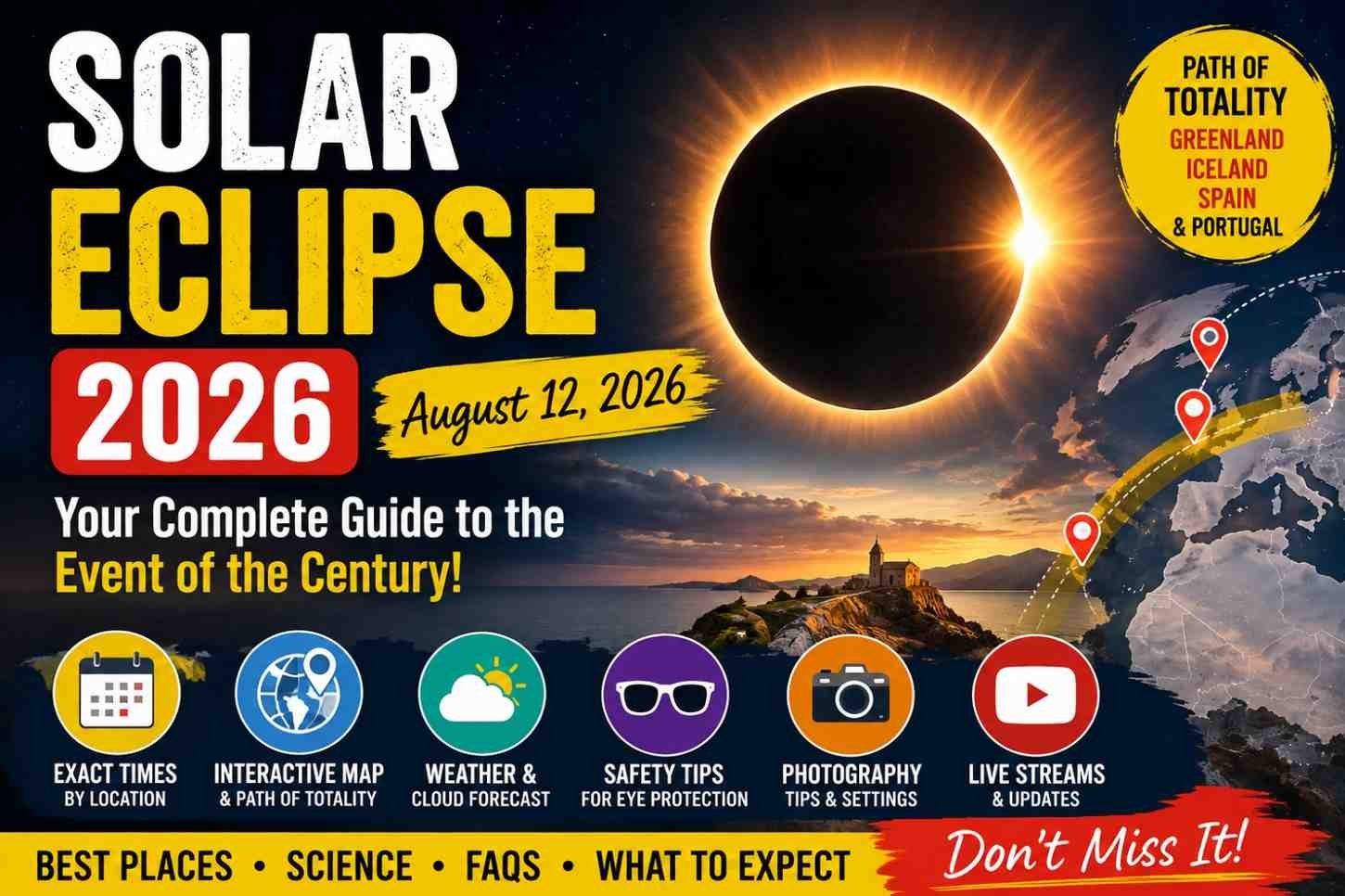
The August 12, 2026 total solar eclipse crosses Greenland, Iceland, Spain, and a small part of Portugal, while a partial solar eclipse is visible across a much larger portion of Europe and surrounding regions. NASA also lists northern Russia in the total eclipse path.
This one feels big. Really big.
People traveled far just to stand under that dark Sun for few minutes. Spain alone expected millions of eclipse visitors, while Iceland also saw strong traveler rush. For many places in Europe, you don’t get total darkness, but still a very deep partial eclipse. London, for example, gets about 91.4% Sun coverage.
But seeing it is not only “look up and wow.” Weather can fail. Clouds can come. Wrong place means no totality.
So here we go practical—exact solar eclipse 2026 times, interactive path map, live weather and cloud checks, Spain vs Iceland vs Greenland, safe viewing, photography tips, live streams, and what actually happened after the eclipse.
Solar Eclipse 2026 Quick Facts
The solar eclipse 2026 happens on August 12, 2026. This one is a total solar eclipse, but not everybody will see full darkness. NASA says totality crosses Greenland, Iceland, northern Russia, Spain, and a small corner of Portugal. Many other places across Europe, North America, and northwest Africa see only a partial eclipse.
| Detail | Answer |
|---|---|
| Eclipse date | August 12, 2026 |
| Eclipse type | Total solar eclipse |
| Main totality countries | Greenland, Iceland, Spain, small part of Portugal |
| Wider visibility | Partial eclipse across much of Europe and other regions |
| Best experience | Inside the path of totality |
| Eye protection | Required during all partial phases |
| Safe naked-eye viewing | Only during complete totality |
| Main weather concern | Clouds near eclipse time |
One thing people sometimes get wrong: 99% eclipse is not same as totality. Even that tiny 1% of Sun still very bright. You need proper eye protection. But inside true totality, Moon covers the bright Sun fully for a short time, and that is when the sky changes in a very different way.
What Time Is the Solar Eclipse on August 12, 2026?
There is one thing I would not do on eclipse day: copy one “solar eclipse 2026 time” from Google and think it works everywhere. It does not.
The Moon’s shadow keeps moving. So your partial eclipse begins, maximum eclipse, totality, and ending time change with your location. Worldwide, the first partial phase starts at 15:34:15 UTC, while maximum eclipse happens at 17:46:06 UTC.
Solar Eclipse 2026 Timings by Location
Here are useful local examples. Times are local and rounded where needed.
| Location | Partial starts | Totality starts | Maximum | Totality ends | Partial ends | Totality | Sun altitude |
|---|---|---|---|---|---|---|---|
| Reykjavík, Iceland | 16:47 | 17:48 | 17:48 | ~17:49 | 18:47 | 58 sec | ~24.5° |
| A Coruña, Spain | 19:30 | ~20:27 | 20:28 | ~20:29 | 21:22 | 1m 17s | Low west |
| Gijón, Asturias | 19:31 | ~20:26 | 20:27 | ~20:29 | 21:20 | 1m 45s | Low west |
| Zaragoza, Spain | 19:34 | ~20:28 | 20:29 | ~20:30 | ~21:09 | ~1m+ | ~6° |
| Valencia area | ~19:38 | ~20:32 | 20:32 | ~20:33 | ~21:01 | ~1 min | 4.6° |
| Palma, Mallorca | 19:38 | 20:31 | ~20:32 | ~20:33 | ~20:53 | ~1 min | Very low |
| Bragança, Portugal | 18:33 | ~19:30 | ~19:30 | ~19:30 | 20:24 | Seconds only | Very low |
| Porto, Portugal | 18:34 | — | 19:32 | — | 20:25 | No totality | — |
Sources: Timeanddate local eclipse calculations and Reykjavík tourism eclipse data.
That low Sun matters more than people first think. In Valencia, totality starts with the Sun only 4.6° above the horizon. A hill, apartment, even some trees can spoil your view.
And asking, “What percentage of the Sun will be covered where I live?” is equally important. Porto gets about 98.22% obscuration, yet no totality. Gijón gets 100%. That tiny difference changes the whole experience.
Before leaving home, put your exact town into an interactive eclipse map. I would check it twice—timing, totality, and western horizon. One nearby town can give you a very different sky.
Solar Eclipse 2026 Path of Totality and Interactive Map
The solar eclipse 2026 path of totality is the thin area where the Moon covers the Sun fully. On August 12, 2026, this path moves across northern Russia, Greenland, Iceland, the Atlantic, Spain, and a small corner of Portugal. NASA confirms many other places in Europe, North America, and northwest Africa see only a partial eclipse.
This small path matters more than I first thought.
Inside it, you stand under the Moon’s dark central shadow, called the umbra. Outside this line, you stay in the lighter shadow and see only part of Sun covered.
And 99% is not same as 100%. It sounds almost same on paper. But your eyes tell another story. At 99%, a small bright Sun piece still remains. At 100% totality, that bright surface disappears, sky goes much darker, and the solar corona can show. So, when planning travel, I would not choose a place only because it says “99% eclipse.” I check that totality border carefully.
Interactive Solar Eclipse 2026 Map
NASA’s interactive 2026 eclipse map is useful here. Its blue lines mark the north and south limits of totality, while the red line shows the center path. Click a point and NASA provides local eclipse contact times and totality duration.
Use the map before leaving home:
- Search your town.
- See if it sits inside totality.
- Check local eclipse coverage.
- Note totality duration.
- Check Sun height and direction.
Image alt text: “Solar eclipse 2026 path of totality through Greenland, Iceland, Spain and Portugal.”
What Is a Solar Eclipse?
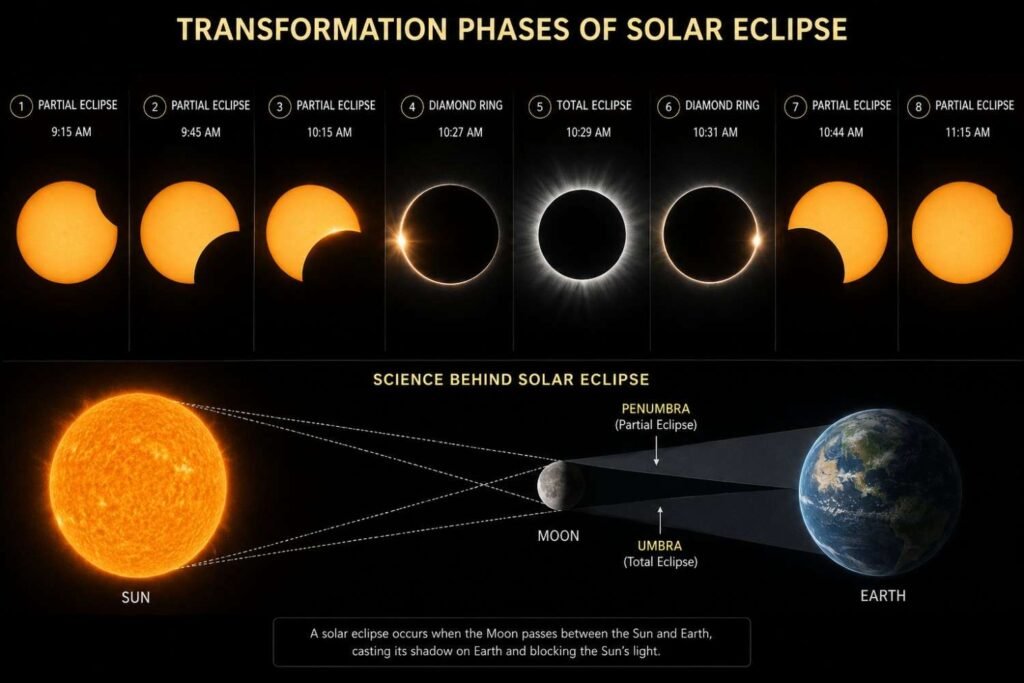
A solar eclipse happens when the Moon moves between Earth and the Sun. For some time, Moon blocks Sun light and its shadow falls on Earth. Simple idea, but when you see it happening, it does not feel simple at all. Sky can become strange dark. Temperature may fall. Birds and animals may react like evening came early. NASA says solar eclipse can happen only around a new Moon, when Sun, Moon and Earth get the needed alignment.
I think one confusing thing for many people is this: if new Moon comes every month, then why no eclipse every month? Moon orbit is tilted compared with Earth’s path around Sun. So most months its shadow passes above or below Earth. Only during an eclipse season, when the bodies line up correctly, eclipse becomes possible.
How common is solar eclipse?
More common worldwide than many of us think. NASA’s eclipse catalog says 224 solar eclipses occur during 2001–2100: 77 partial, 72 annular, 68 total and 7 hybrid. But from one same place, seeing total eclipse is much rare. NASA calculations give an average near once every 375 years for one location, though real gaps can differ a lot.
People were watching these dark Suns long before modern telescopes. Maya people recorded eclipses carefully, and their astronomy records even allowed eclipse prediction. Later, eclipses became powerful science moments. Scientists used them to study Sun’s outer atmosphere and even test ideas linked with general relativity.
Small eclipse glossary
- Umbra: darkest Moon shadow; total eclipse happens here.
- Penumbra: lighter shadow; you see partial eclipse.
- Corona: Sun’s outer atmosphere, visible beautifully during totality.
- Annular eclipse: Moon looks little smaller, leaving bright Sun ring.
- Totality: short time Sun face gets fully covered.
And one important effect we should not forget: darkness does not mean Sun became safe. During partial stages, your eyes still need proper solar protection.
Where Is the Best Place to See the 2026 Solar Eclipse?
The best place to see the 2026 solar eclipse is not just the place having longest totality. I would look at five things first: clear sky chance, totality time, Sun height, open western horizon, and how easily I can move if weather becomes bad.
This part becomes very important. On August 12, 2026, totality crosses Greenland, Iceland, Spain and a small corner of Portugal. NASA gives maximum totality of about 2 minutes 18 seconds for the eclipse.
A beautiful place means little if one thick cloud sits in front of Sun.
Spain vs Iceland vs Greenland for the 2026 Eclipse
| Factor | Spain | Iceland | Greenland |
|---|---|---|---|
| Accessibility | Excellent | Good | Difficult |
| Weather reliability | Generally stronger in selected areas | More variable | Highly location-dependent |
| Accommodation | Extensive but crowded | Limited/high demand | Limited |
| Road mobility | Strong | Moderate | Limited |
| Scenery | Excellent | Exceptional | Exceptional |
| Best for | Most travelers | Adventure + scenery | Experienced eclipse travelers |
Spain — Best for Accessibility and Flexible Viewing
For most people, Spain is the practical choice.
The totality path cuts across a large part of northern Spain and reaches the Mediterranean side and Balearic Islands. Galicia, Asturias, Castilla y León, Aragón, Mediterranean Spain and Mallorca all give different choices.
What I like here is roads.
Suppose morning cloud comes over your planned field. In many parts of Spain, you have some chance to drive toward another viewing area. That freedom matters more than people think.
But there is one trouble. The Sun is low toward the western horizon during the Spanish eclipse. A hill, building, trees, even wrong side of a valley can spoil your view. So I would personally check the horizon one day before, not just arrive and hope.
Crowds also real problem. Spanish authorities prepared hundreds of official viewing areas, while some locations faced restrictions because of wildfire danger.
Iceland — Best for Dramatic Scenery
Iceland can give one of those views people remember whole life. Ocean, cliffs, lava ground, mountains, then black Sun above it.
But weather can play badly here.
The Icelandic Meteorological Office provides separate low, middle and high cloud forecasts. That is what I would watch, not only a normal rain app.
Have two or three backup places. Iceland roads give some movement, but not same freedom as mainland Spain. Accommodation also gets tight near major viewing zones.
Greenland — Best for an Expedition Experience
Greenland feels different. This is less “drive somewhere and watch eclipse,” more like real expedition.
Remote coast, mountains, limited roads, fewer rooms, boats or organized eclipse trips may become part of whole plan. Some specialist expeditions planned viewing close to the eclipse centerline in East Greenland.
For an experienced eclipse chaser, that isolation may be exactly the dream.
For a first-time traveler? I would choose Spain.
You get more escape routes when clouds change their mind.
Solar Eclipse 2026 Weather and Live Cloud Forecast
Weather may be the hardest part of the Solar Eclipse 2026 plan. You can book a hotel months before, buy glasses, choose perfect place. But one cloud at wrong time, and whole totality can disappear.
Historical weather data is useful early. Spain’s official eclipse information uses 16 years of AEMET data to show where clear or partly clear skies happened more often around the August 12 eclipse period. But history is not today’s sky. Close to eclipse time, I would trust fresh forecast, satellite images, and what clouds are actually doing around me much more.
How to Check Cloud Cover Before Totality
Do not see only one number saying “50% cloudy.” That number can hide the real problem.
I check these separately:
- Low cloud: often the big trouble. Thick low cloud can fully hide Sun.
- Mid-level cloud: watch how fast patches are moving.
- High cloud: thin high cloud may still allow some eclipse view.
- Rain chance: useful, but rain percentage alone does not tell Sun visibility.
- Satellite image: this is where I keep looking close to totality.
- Wind: tells me where cloud may move next.
- Visibility: haze, dust, smoke and moisture can make a low Sun harder to see.
This mattered a lot in Spain today. AEMET expected mostly clear sky over much of the country, while the Cantabrian coast, northern Galicia and Pyrenees had much more cloud risk. Iceland was a different gamble, with less friendly weather prospects in current reports.
Should You Move if Clouds Are Forecast?
I would never depend on one viewing point.
Plan A: Your preferred eclipse place.
Plan B: Another place around 1–2 hours away.
Plan C: Longer escape route if cloud pattern becomes clearly bad.
But don’t start driving just because one weather app shows cloud. Move when another location looks clearly better, roads are open, you can reach it well before totality, and parking is possible.
Sometimes chasing clear sky creates bigger problem than cloud itself.
Last weather update: August 12, 2026 — check your local forecast again before leaving.
How to Watch the 2026 Solar Eclipse Safely
Solar eclipse looks peaceful. But the Sun is still the Sun. Very bright, very strong. Your eyes do not get some special protection because Moon coming in front of it. This is the part I would never take lightly.
When Eclipse Glasses Are Required
During every partial phase of the 2026 solar eclipse, wear proper eclipse glasses or use a safe handheld solar viewer. Normal sunglasses are not enough, even very dark ones. NASA says eclipse viewers are thousands of times darker than regular sunglasses.
Only during complete totality, when the Moon fully blocks the Sun’s bright face, you can look without eclipse glasses. The moment even a small bright part of Sun comes back, glasses go back on. Immediately.
If you are outside the path of totality, there is no safe glasses-off moment.
How to Choose Safe Eclipse Glasses
Look for solar viewers that comply with ISO 12312-2, the international standard made for direct Sun viewing. ISO confirms this standard applies to products made for solar observation.
But I would not trust only words printed on cheap packaging. American Astronomical Society warns that anybody can print an ISO claim.
Before using your pair:
- Check lens for scratches, holes or tears.
- Throw damaged glasses away.
- Buy from a reliable solar-viewer supplier.
- Don’t search for “NASA-approved eclipse glasses.” NASA says it does not approve any particular brand.
Cameras, Binoculars and Telescopes
This mistake can become serious very fast.
Never look through binoculars, telescope, or camera lens using only eclipse glasses. Magnifying optics concentrate sunlight. NASA says these devices need their own proper solar filter fitted on the Sun-facing front end.
No Eclipse Glasses? Use Pinhole Projection
No glasses is frustrating, yes. Still don’t experiment with sunglasses, smoked glass, film, or random dark plastic.
Make a simple pinhole projector instead. Keep the Sun behind you, let sunlight pass through a tiny hole, and watch the projected image on paper or another surface. Never look through that hole toward Sun. It is simple, little old-school, but safe when done correctly.
How to Photograph the Solar Eclipse 2026
Taking a photo of solar eclipse 2026 sounds easy. Sun is there, camera is there, click it. But when the eclipse really start, things become little messy. Light changing fast. Hands shaking. Camera suddenly not focusing. And you may spend whole totality looking at tiny screen, which I feel is the biggest mistake.
Photographing With a DSLR or Mirrorless Camera
First, practice on the normal Sun before August 12. Not on eclipse day first time.
During the partial phases, your camera lens need a proper solar filter fixed over the front of the lens. NASA says normal eclipse glasses are not a replacement for camera-lens solar filters. The filter can come off only during complete totality, when the Moon fully covers the bright Sun.
My simple setup would be:
- Put camera firmly on tripod.
- Frame the Sun early.
- Focus carefully, then lock manual focus.
- Use manual exposure.
- Shoot RAW if your camera allow it.
- Take different exposures during totality.
- Use interval shooting or remote shutter when possible.
Why different exposures? Corona is not one simple brightness. One setting may show inner corona nicely but lose faint outer parts. NASA eclipse photography guidance also recommends varying exposures for corona detail.
Don’t only chase one photo. Try partial Sun, thin crescent, Baily’s beads, diamond ring, corona, then one wide photo where people, land and dark sky all appear.
That last picture sometimes tells more story.
Photographing the Eclipse With an iPhone or Android Phone
Phone users have another problem—zoom.
You pinch, pinch again, and Sun become bigger but photo become ugly. Digital zoom cannot create missing detail.
Keep phone stable against tripod or small mount. Tap the Sun area and reduce exposure so bright parts don’t become one white ball. For partial phases, use solar-filter protection intended for solar imaging; never look through unfiltered optics while aiming the device. NASA warns that concentrated sunlight through unfiltered optical equipment can seriously injure eyes.
Shoot few photos. Maybe short video too.
But when totality comes, stop fighting your phone.
Look up.
You waited for this.
Where to Watch the Solar Eclipse 2026 Live Online
Clouds can ruin the view. Or maybe you are sitting far away from the eclipse path, like me many times with sky events. In that case, a Solar Eclipse 2026 live stream is the easy backup. NASA starts its official coverage at 1:15 p.m. EDT, with telescope views, experts, and even footage from its WB-57 research aircraft.
| Stream | Start time | Location/feed | Watch |
|---|---|---|---|
| NASA | 1:15 p.m. EDT | Multiple eclipse locations + aircraft | NASA Live |
| ESA | 19:30 CEST | Javalambre Observatory, Spain | ESA Web TV / YouTube |
| Royal Observatory Greenwich | 1:15 p.m. EDT | Telescope feed + expert talk | YouTube |
| Virtual Telescope Project | 1:20 p.m. EDT | Italy/Spain feeds | Online stream |
ESA says its English broadcast comes from Observatorio Astrofísico de Javalambre in Teruel, Spain, beginning around 19:30 CEST.
I would open two streams before eclipse time. Internet can slow, links can freeze, audio sometimes goes strange. One backup saves the moment. Other astronomy groups are also carrying free coverage.
Live stream information will be updated as official broadcasts are announced.
What Happens During Totality?
Totality does not feel like normal sunset. It comes fast. The light becomes strange, almost grey, and you may suddenly feel the air getting cooler. During the 2017 eclipse, NASA citizen-science observations recorded temperature falling by several degrees as the Moon’s shadow passed.
Watch the Sun’s edge carefully—but only with proper eye protection before totality. Small bright dots called Baily’s beads appear when sunlight passes through valleys on the Moon. Then one bright point remains. This is the diamond ring effect.
Then totality starts.
The bright Sun disappears, but around the black Moon you see the pale solar corona. Stars and bright planets may become visible. Shadows around you also look odd. I would stop looking at my camera here. Just look around too.
Nature may react. NASA observations report birds becoming quiet, crickets starting to chirp, and bees returning toward their hives, like evening came suddenly. Wind can also slow as the ground cools. Research during earlier eclipses measured changes in both temperature and wind.
The eclipse has four contacts: first contact starts the partial eclipse; second contact starts totality; third contact ends totality; fourth contact is when the Moon finally leaves the Sun. When third contact comes, put your eclipse glasses back immediately.
What If Something Goes Wrong? Real-World Eclipse Problems and Solutions
Eclipse day can look perfect on paper. Then real life comes. Cloud. Traffic. Dead phone. I have learned one simple thing from outdoor trips: never keep only one plan.
Clouds over your viewing place? Don’t panic and drive after every small blue hole in sky. Check satellite images and low, middle, high cloud layers first. If another place looks clearly better, move early. Not ten minutes before totality.
Eclipse glasses sold out? This one is serious. Never replace them with normal sunglasses, dark plastic, or some homemade glass. NASA says partial phases need proper solar viewing protection. A pinhole projector gives you a safe indirect way to see the eclipse.
Traffic not moving? Eclipse roads can become headache fast. Reach your area hours early. Save offline maps too.
Phone signal gone? Very possible when many people reach one area. Keep hotel address, parking spot, tickets, map pin, and family meeting place saved before leaving.
Camera problem? Autofocus sometimes hunts badly near the darkening Sun. Focus earlier, then switch manual. Battery dying feels even worse. Carry spare charged batteries and power bank.
Hotel cancelled? Look beyond famous eclipse towns. A simple room farther away may save the whole trip.
And check your map twice. The August 12, 2026 path of totality crosses places including Greenland, Iceland, northern Russia, Spain and a small corner of Portugal. If your hotel sits outside totality, see whether you can safely travel inside the path early. A small planning mistake should not become the memory of your whole eclipse.
Solar Eclipse 2026 Live Updates and Post-Eclipse Results
Last Updated: August 12, 2026
The solar eclipse 2026 story is still moving. So, I would not close this page after eclipse time. Weather change, roads get busy, clouds come and go. Your perfect place morning time may become bad place evening.
Before the Eclipse
Spain prepared 350 official viewing areas, while access at 123 locations was limited because of wildfire and safety risk. More than 33,500 law officers were prepared for the event. Around 6 million visitors were expected across Spain’s eclipse regions, while Iceland expected about 80,000 visitors.
So before leaving, check cloud forecast, road closure, local rules and your second viewing place. I always feel one backup location is not enough.
During the Eclipse
Here we will update cloud cover, actual visibility, crowd situation, photos and working solar eclipse 2026 live streams. NASA’s broadcast starts at 1:15 p.m. EDT, including telescope views and footage from its WB-57 research aircraft.
After the Eclipse
Then comes the useful part. We will compare where totality was clear, where cloud spoiled it, real weather, traveler experiences and best photographs. Also photography mistakes, scientific observations and new research results will be added. No guessing. If something failed, we show what happened, and what eclipse watchers can learn for the next one.
Solar Eclipse 2026 FAQs
When is the solar eclipse in 2026?
The big solar eclipse 2026 happens on Wednesday, August 12, 2026. This one is a total solar eclipse. NASA says the Moon’s shadow moves across northern Russia, Greenland, Iceland, Atlantic Ocean, Spain, and a tiny corner of Portugal.
Is the August 12, 2026 eclipse total or partial?
Both, actually. If you stand inside the narrow path of totality, Moon covers the full bright face of Sun. Outside that path, you only get partial eclipse. Even 99% is not same feeling as totality. Small sunlight still stays very bright.
Which countries will see totality in 2026?
Totality reaches northern Russia, Greenland, Iceland, Spain, and a small northwestern part of Portugal. NASA map shows this narrow band clearly. Many more places in Europe, Canada, northern U.S., and northwestern Africa see only part of Sun covered.
Where is the best place to watch the 2026 solar eclipse?
There is no one perfect place. Spain gives better roads and many choices if clouds come. Iceland gives crazy beautiful land, but weather can change fast. Greenland feels like lifetime adventure, though travel is harder. I would first check clouds, road movement, horizon, then scenery.
How long will totality last?
It changes place to place. NASA says most people inside totality get less than two minutes, while places near center of the eclipse path can get a little longer, still under two and half minutes. Check your exact point on an eclipse map.
Can I see the 2026 eclipse from the United States?
Yes, but not totality. Parts of the northern U.S., roughly from Alaska to North Carolina, can see a partial eclipse. Coverage changes a lot by city, so don’t copy somebody else’s eclipse time. Put your own city in an eclipse map.
Can I see the solar eclipse from India?
No. The August 12 eclipse is not visible from India. The eclipse takes place when India is outside the Moon-shadow viewing area. So Indian readers wanting to watch it need an online broadcast or travel into the eclipse path.
Do I need eclipse glasses?
Yes, during every partial stage. Only during complete totality you can remove proper solar viewers. Once bright Sun starts coming back, glasses go back immediately. NASA recommends viewers meeting the ISO 12312-2 standard.
Can I use sunglasses?
No. Even very dark sunglasses are not eclipse glasses. They do not block dangerous sunlight enough. This small shortcut simply not worth your eyes.
Can I photograph the eclipse with my phone?
Yes, but don’t simply point your phone toward bright Sun and stare at screen. Proper solar filtering matters during partial phases. For cameras, NASA says special-purpose solar filters should go on the front of the optics.
What happens if it is cloudy?
This hurts, especially after long travel. Keep two or three backup places before eclipse day. Watch cloud maps, road conditions, and move early if another location looks clearly better. If sky completely fails, keep a livestream ready. Sometimes clouds break. Sometimes they don’t.
Will there be a livestream?
Yes. NASA confirmed a live eclipse broadcast starting 1:15 p.m. EDT on August 12, with views from across the eclipse path and expert discussion.
When is the next total solar eclipse?
The next total solar eclipse after this one is August 2, 2027. NASA says totality crosses southern Spain, North Africa, Saudi Arabia, and Yemen. Spain gets another chance only one year later.
Final Checklist for August 12, 2026
The solar eclipse 2026 is here on August 12, 2026. Maybe you planned this day for months. Maybe you only heard about it yesterday. Either way, last few hours before eclipse can become messy very fast. Roads fill. Clouds come from nowhere. Phone battery goes down. And one small mistake, like standing few miles outside totality, can change whole experience.
So before you leave, check things one more time.
First, make sure you are really inside totality
Do not trust only hotel name, town name, or somebody saying, “Yes, eclipse comes here.”
Open a reliable 2026 solar eclipse path map and check your exact viewing point.
The August 12 eclipse path of totality crosses Greenland, Iceland, northern Spain, and a very small part of Portugal. Outside that narrow path, you only see a partial eclipse.
This part matters more than people think.
A place showing 98% or 99% eclipse is still not same thing as totality. That remaining bright piece of Sun keeps sky much brighter. You miss the full dark sky and proper corona experience.
Save your GPS point. Screenshot the map also. Internet may become slow when many people gather in one area.
Save your local eclipse times, not somebody else’s time
I would keep three times in my phone and also write them somewhere:
- Partial eclipse starts
- Totality starts and ends
- Partial eclipse finishes
Your nearby city may have slightly different timings from your viewing field or beach.
Set alarms before important stages. But don’t depend only on alarms. When people talk, take photos, search clouds, and move bags around, five minutes can disappear strangely quick.
Look where the Sun will actually be
A perfect field is useless if a hill, building, trees, or mountain blocks the Sun at eclipse time.
This is one thing easy to forget.
Stand at your planned spot earlier. Look toward the Sun direction. Check the horizon. In Spain especially, this eclipse happens later in the day, so horizon choice becomes important.
If you see a big mountain sitting exactly where the Sun will go, move now. Not ten minutes before totality.
Check your eclipse glasses again
NASA says safe solar viewers should comply with the ISO 12312-2 international standard. Normal sunglasses, even very dark sunglasses, are not safe for looking at the Sun.
Look at your glasses before using.
Bent frame is not big issue maybe. But scratched, torn, punctured, or damaged filter? I would not gamble my eyes for two minutes of sky.
Also, printing “ISO 12312-2” on glasses alone does not prove a product is genuine. The American Astronomical Society warns that anybody can print such words on a product, so source and manufacturer reliability also matter.
And keep one spare pair. Glasses get dropped. Kids bend them. Wind takes them.
Watch clouds, but don’t become slave to every weather app
Eclipse chasing has a funny problem. You can have five weather apps and five different feelings.
Instead, watch the useful things:
low cloud, middle cloud, high cloud, rain, satellite movement, and wind direction.
Then prepare three places.
Plan A — Your main viewing location.
Plan B — A nearby place you can reach without panic.
Plan C — A farther option only if weather really looks much better there.
Don’t keep driving endlessly chasing one blue hole in clouds. I have seen this type of planning become worse than staying put. You need enough time to park, walk, set equipment and settle yourself.
Sometimes cloud moves. Sometimes it doesn’t. There is no perfect control here.
Prepare for roads and weak phone network
Download your map for offline use.
Screenshot:
- Viewing coordinates
- Hotel address
- Parking place
- Backup locations
- Important tickets
- Route back
- Meeting point for family or friends
If thousands of phones hit one tower together, your beautiful online map suddenly becomes a blank screen. So old style information saved inside phone is useful again.
Fill fuel before entering busy eclipse areas. Carry water too. A two-hour drive can turn longer when everyone leaves after totality at nearly same time.
Charge everything, then stop touching everything
Phone 100%.
Camera batteries 100%.
Power bank full.
Memory cards empty enough.
Tripod packed.
Solar filter packed.
Cables packed.
Do this before leaving.
Photography becomes exciting and dangerous in another way—not for eyes only, but for your experience. You can spend the whole totality looking at camera menus.
Set camera early. Focus early. Test it.
Then when totality comes, give your own eyes some time.
You traveled all this way to see it, not only to bring home 800 files.
Arrive earlier than you feel necessary
When you arrive early, boring is good.
You walk around.
Check horizon.
Talk to people.
Find toilet.
Set tripod.
Drink water.
Watch clouds.
Then nothing is rushed.
Arriving at last minute creates strange mistakes. Wrong camera setting. Lost glasses. Park too far. Family member still walking from car. Everybody irritated before something beautiful even starts.
Give yourself room.
Partial eclipse means glasses stay on
This rule is simple.
Before totality and after totality, when any bright part of the Sun is visible, NASA says you need proper solar viewing protection for direct viewing.
Don’t copy another person just because they removed glasses.
Don’t think, “It looks dark enough.”
Partial Sun is still Sun.
NASA and the National Solar Observatory both state that direct naked-eye viewing is safe only during the brief total phase, when the Moon fully blocks the Sun’s bright face.
Then totality comes. Look up.
This is the part I would keep simple.
Camera running?
Fine.
Phone recording?
Fine.
Now leave them.
Look.
You may see the bright corona around a black Moon. Sky changes fast. Horizon can look strange. People around you may shout. Some become silent.
Nobody reacts exactly same way.
And totality is short. So don’t spend half of it checking whether your photo was sharp.
Photos can wait.
Bright Sun returns? Glasses back on immediately
This transition can catch people.
Totality ends and a brilliant point of sunlight returns. That is your signal.
Eyes protected again.
NASA says viewers should put eclipse glasses back on as soon as the bright Sun starts appearing after totality.
Don’t wait until it “looks bright.”
That first bright piece already matters.
My final August 12 checklist
Before moving toward your solar eclipse 2026 viewing location, I would check this once:
- [ ] Exact viewing point is inside path of totality
- [ ] Local eclipse start time saved
- [ ] Totality start and end times saved
- [ ] Sun direction and horizon checked
- [ ] ISO 12312-2 solar viewers ready
- [ ] Spare solar viewer packed
- [ ] Glasses checked for damage
- [ ] Latest cloud forecast checked
- [ ] Plan A viewing place ready
- [ ] Plan B location saved offline
- [ ] Plan C location saved if really needed
- [ ] Offline maps downloaded
- [ ] Fuel/transport sorted
- [ ] Water and small food packed
- [ ] Phone fully charged
- [ ] Power bank charged
- [ ] Camera batteries charged
- [ ] Memory cards checked
- [ ] Camera solar filter packed
- [ ] Tripod ready
- [ ] Arrive with plenty time
- [ ] Glasses stay on through partial phases
- [ ] Glasses come off only during complete totality
- [ ] Stop playing with camera and actually watch
- [ ] Glasses return immediately when bright Sun comes back
There will always be something you cannot control on August 12, 2026. Cloud can move wrong way. Traffic can surprise you. A camera can suddenly decide today is the day it doesn’t work.
But the basic things, we can control those.
Know your place. Know your time. Protect your eyes. Have another location ready. Get there early.
Then, when the Moon finally covers the Sun, don’t make the moment complicated.
Just look up.
Conclusion
The solar eclipse 2026 on August 12 is more than looking up and seeing Moon cover Sun. Your place, local eclipse time, clouds, road situation, and eye safety can change whole experience. Spain alone prepared for huge visitor crowds, while Iceland also became a major eclipse travel place.
So keep this page bookmarked. I will use it for checking local eclipse times, changing weather and cloud updates, new livestream links, travel warnings, and later the real photos and science results. One thing please don’t take lightly—during partial phases, normal sunglasses are not safe; NASA says proper solar viewers are needed.
Next: Best Places to See the 2026 Solar Eclipse: Spain vs Iceland vs Greenland.
Read Next: India August 15th Independence Day 2026.
Latest news about Hayden Panettiere.
