
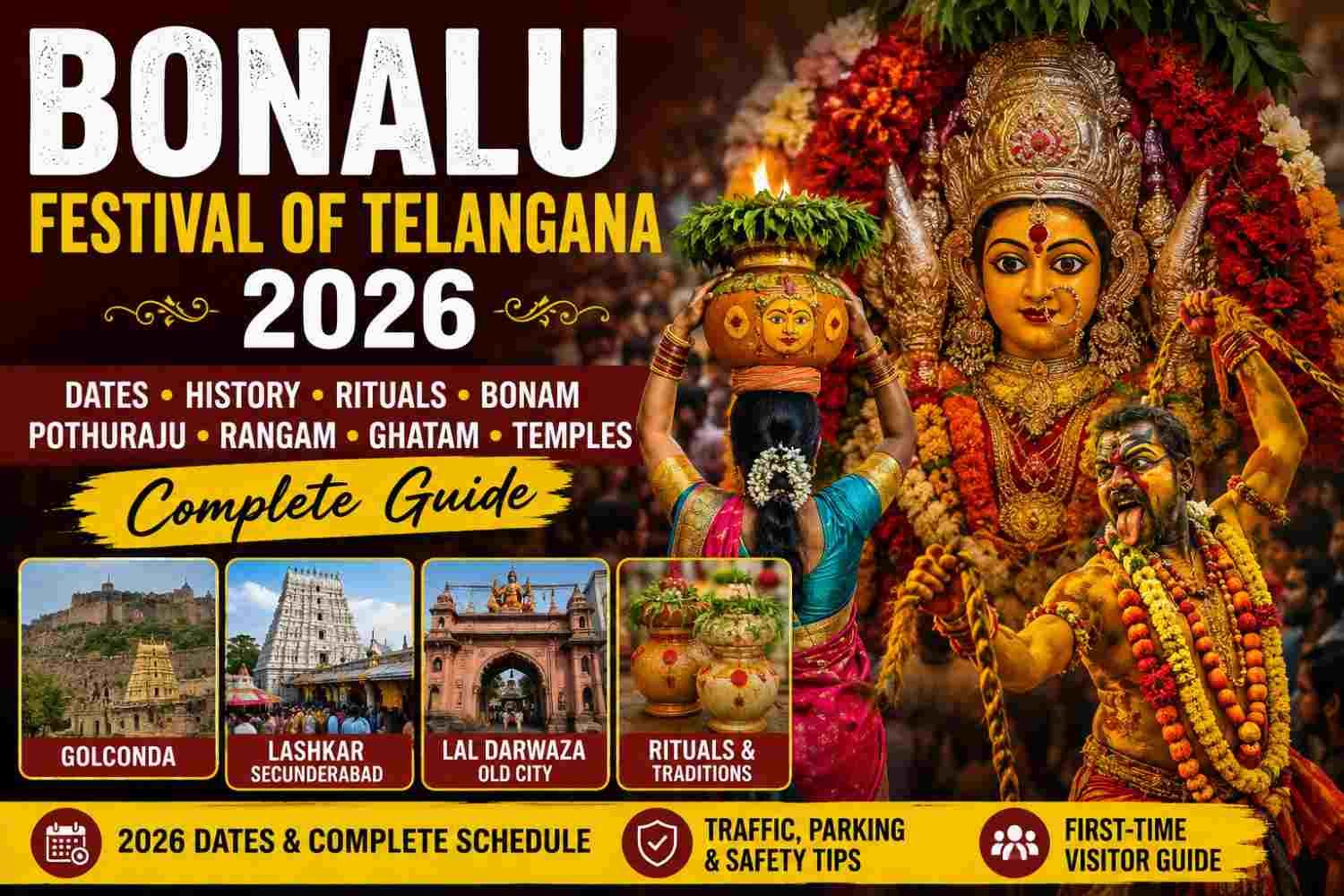
Bonalu Festival of Telangana is not just one temple festival. You see whole streets change. Drums, neem leaves, decorated pots, crowds, prayers, and that strong Pothuraju dance coming before the procession. Bonalu mainly worships Goddess Mahakali and is celebrated across Telangana, with Hyderabad and Secunderabad having some of the biggest celebrations.
Quick answer: Bonalu comes during Ashada Masam. Women offer Bonam, while traditions such as Pothuraju, Rangam and Ghatam form important parts of different celebrations.
For Telangana Bonalu 2026, the official Telangana calendar marks Bonalu on August 10, 2026. But this date alone can confuse you—Golconda, Secunderabad and Old City celebrations happen on different festival days.
Last updated: August 8, 2026
2026 note: Dates, temple events and traffic plans should be checked again before visiting.
Jump to: Dates • Schedule • History • Bonam • Pothuraju • Rangam • Ghatam • Visitor Guide
What Is Bonalu Festival?
Bonalu is one of those festivals where you may understand Telangana little better when you see it near temple, not only read about it. Drums sound from street. Women carry decorated pots on head. Families come together. Some people are praying quiet, some dancing, some waiting for darshan. Main worship is for Goddess Mahakali, and Bonalu is strongly seen in Hyderabad, Secunderabad and other Telangana places.
Meaning of Bonalu
People often ask, what is Bonalu meaning in Telugu? The word connects with Bonam. Bonam literally means “meal” in Telugu, according to Telangana government information. This meal is prepared as an offering to Mother Goddess.
So Bonalu is not simply carrying one colorful pot.
That pot has devotion inside it.
Women traditionally prepare Bonam and take it towards temple. When you watch the street full of these pots, neem leaves and temple sounds, word “festival” feels little small for it.
Which Goddess Is Worshipped During Bonalu?
Mainly Goddess Mahakali is worshipped during Bonalu. But Telangana village goddess tradition is wider. In different local areas, people may worship Ammavaru in forms connected with Yellamma, Pochamma, Mysamma, Peddamma, Maremma and other village goddesses.
Yellamma worship also has special place during Bonalu traditions.
This sometimes confuse outside visitor. “Which goddess is Bonalu for?” Answer is Mahakali mainly, but local Ammavaru traditions can change place to place.
Why Bonalu Is Important to Telangana Culture
Bonalu is not standing only inside temple walls. It comes to road, family and neighborhood.
Women have a very visible place in it, carrying Bonam in traditional dress, while folk music, dancing and Pothuraju-led movement make streets active. Telangana Tourism describes Bonalu as part of the state’s folk and spiritual culture.
In Hyderabad, it also becomes part of city memory. One generation watches another generation doing same offering. That is where Bonalu become more than ritual. It becomes Telangana identity people can actually see.
When Is Bonalu 2026?
If you are searching when is Bonalu 2026, one date can make little confusion. The Telangana Government calendar marks Monday, August 10, 2026, as Bonalu. But this does not mean whole Bonalu happens only on August 10. Festival celebrations move through different temples and areas during Ashada Masam, normally falling around July and August.
Bonalu 2026 Date
The official Bonalu holiday 2026 in Telangana is August 10, Monday. If you only need government holiday date, keep this date.
But for seeing actual Bonalu, you need look little deeper.
Bonalu belongs with Ashada Masam. Telangana Tourism says the festival is usually celebrated during this Hindu month, which falls in July/August. So, one calendar date never tells complete festival story.
Why Does Bonalu Have Different Dates?
This confused me first while checking Bonalu dates. One page shows one day, another temple shows another. It may look wrong. Mostly, it is not.
Bonalu does not happen at one temple on one Sunday. Celebrations move through different parts of Hyderabad and Secunderabad. Golconda has its tradition, Secunderabad has the famous Ujjaini Mahankali celebrations, while Old City temples follow their own festival days and processions. Telangana’s official tourism information also describes Bonalu as celebrations spread across Hyderabad and Secunderabad rather than one single event.
So remember this small rule: government Bonalu holiday ≠ only Bonalu celebration date.
How Long Does Bonalu Last?
Bonalu is better understood as a festival season. Government tourism information describes month-long festivities during Ashadam, with worship, Bonam offerings and temple celebrations happening across the period.
If you are planning visit, don’t search only “Bonalu date 2026.” Check the specific temple, area and celebration date also. That small check can save you from reaching wrong place on wrong day.
Bonalu 2026 Complete Hyderabad Schedule
Finding the Bonalu 2026 dates in Hyderabad can confuse you little. I had same question while checking it. One page says one Sunday, another place shows different date. Reason is simple. Bonalu is not happening at one temple on one day. It moves through Golconda, Secunderabad and finally Old City areas during the festival season. The Hyderabad district government also describes this temple-to-temple pattern as part of Bonalu tradition.
| Celebration | Temple/Area | 2026 Date | Main Ritual/Event | Visitor Note |
|---|---|---|---|---|
| Golconda Bonalu | Jagadamba Mahankali Temple, Golconda | July 16 opening; July 19 main Sunday celebration | First Bonam, Ghatam | Festival opening phase |
| Lashkar Bonalu | Ujjaini Mahankali Temple, Secunderabad | August 2 | Bonam, Pothuraju, Mahankali worship | Very heavy crowds |
| Rangam | Ujjaini Mahankali Temple, Secunderabad | August 3 | Rangam oracle ritual | Reach early |
| Lal Darwaza Bonalu | Lal Darwaza, Old City | August 9 | Bonam, Pothuraju, processions | Final major Old City phase |
| Final processions | Old City/Hyderabad | August 10 | Ghatam and concluding events | Telangana general holiday |
The Telangana Government calendar lists August 10, 2026 as Bonalu general holiday. That date should not be confused with the only day of Bonalu. Many important celebrations already happen before it.
Golconda Bonalu 2026 Dates
The festival activity started at Sri Jagadamba Mahankali Temple at Golconda Fort on July 16, 2026, with the opening Bonalu ceremonies. The major Golconda-area Sunday celebrations followed on July 19. When you visit Golconda at Bonalu time, don’t think only about temple darshan. Streets, drums, women carrying Bonam and the Ghatam movement become part of experience. Going earlier is much easier than entering after crowds build.
Secunderabad/Lashkar Bonalu 2026 Dates
The big Lashkar Bonalu at Sri Ujjaini Mahankali Temple, Secunderabad was held on Sunday, August 2, 2026. The next day, August 3, the traditional Rangam programme was held. This is one place where crowd becomes serious. You may come for temple darshan, but suddenly roads around you are full with Bonam groups, drums and Pothuraju movement. So public transport and early arrival make more sense.
Lal Darwaza and Old City Bonalu 2026 Dates
The next major date is Sunday, August 9, 2026, for Lal Darwaza Simhavahini Mahankali Bonalu and celebrations at other major Hyderabad temples. For many visitors this feels like big ending part of Hyderabad Bonalu. Old City lanes become busy. Don’t keep a tight travel plan here. Give your time, walk where police allow, and expect route changes.
Rangam and Ghatam Dates
At Secunderabad, Rangam followed Lashkar Bonalu on August 3. Ghatam is not one small event with same timing everywhere; different temple traditions carry it through their festival period, with procession and immersion forming an important closing part. The official Hyderabad district description also records Ghatam processions as a major Bonalu tradition.
Schedule note: Temple timings, traffic restrictions and procession routes can change. Check Telangana Government, temple authorities and Hyderabad Police announcements before travelling.
Why Is Bonalu Celebrated in Telangana?
Bonalu is celebrated mainly to worship Goddess Mahakali and thank her for protection, good health, and family well-being. In Hyderabad, Secunderabad, and many parts of Telangana, this is not looking like only one festival day. For many families, it is something coming from grandparents, streets, temples, and old family promises. Telangana Tourism describes Bonalu as a festival dedicated to Goddess Mahakali, with women carrying Bonam offerings during the celebrations.
Worship of Goddess Mahakali
Mahakali is the heart of Bonalu. People pray to Ammavaru asking protection for home, children, crops, health, and life going peacefully. Different places may worship the Mother Goddess in different local forms. You can see this feeling strongly around Hyderabad temples. It is devotion, but also gratitude. People are not only asking, they are saying thanks for what already came into their life. Telangana’s official tourism material also connects Bonalu directly with Mahakali worship and Telangana’s spiritual culture.
Bonalu and Protection From Disease
There is also an old belief around Bonalu that the Mother Goddess protects communities from disease and trouble. This should be understood as religious tradition and community belief, not medical proof. In earlier times, when people had fewer hospitals and less knowledge about disease, prayer, village gods, vows, and group rituals gave families hope during frightening periods. Even today that feeling remains in many Bonalu traditions.
Thanksgiving and Fulfilment of Vows
A family may prepare Bonam after a prayer was fulfilled, or simply as yearly thanksgiving. Women traditionally carry cooked rice offerings in decorated pots to the Goddess. Government tourism information describes Bonam as a meal offering prepared with cooked rice and other traditional ingredients.
Why Is Bonalu Celebrated During Ashada Masam?
Bonalu comes during Ashada Masam, usually falling around July and August. Telangana government sources identify Ashada as the traditional festival period. For devotees, this month became closely tied with Mother Goddess worship. So the reason behind Bonalu is not one thing alone. It joins devotion, fear, hope, thanksgiving, old vows, family memory, and Telangana identity into one living tradition.
History of Bonalu: Is It 200 or 500+ Years Old?
When I first read about Bonalu history, one thing confused me. Some pages say Bonalu started around 200 years ago. Then newer history evidence says it was there more than 500 years back. So, which one we should believe?
The answer is not very simple. Both stories are talking about different layers of Bonalu.
The Popular 19th-Century Plague Story
The story most Telangana people heard is connected with a serious disease outbreak in Hyderabad and Secunderabad.
According to the Hyderabad District Government, a military battalion from Hyderabad was away in Ujjain, in present-day Madhya Pradesh, when disease was spreading back home. The soldiers prayed to Goddess Mahakali there. They promised that, if their people were protected, they would return and install Mahakali and offer Bonalu to her. The tradition says they later came back and fulfilled that promise.
This became strongly connected with Ujjaini Mahakali Temple in Secunderabad.
For many years, this story worked almost like the starting point of Bonalu history. I can understand why. A disease, worried soldiers, a promise to Goddess, then returning home safely. Such stories stay very strongly inside families.
But one problem comes.
Old stone does not always agree with popular memory.
Was Bonalu Celebrated Before the Plague?
In late 2025, reports about work by the Archaeological Survey of India’s epigraphy division brought a much older clue.
A Telugu inscription from 1516 CE, during the period of Vijayanagara ruler Sri Krishnadevaraya, contains what ASI described as the earliest known epigraphical references to Bonalu. The inscription came from Gobbur and also refers to practices associated with the festival.
Now think about that date.
1516.
That is roughly three centuries before the commonly told 19th-century plague story.
So Bonalu-related worship was probably not simply born one day because plague came to Hyderabad. The practice, or something closely connected with it, seems to have deeper roots.
Why Different Sources Give Different Origins
This is where readers can easily get stuck.
One website repeats the plague story. Temple people may tell a tradition passed from elders. Families hold their own memories. Archaeology comes with an inscription. Modern researchers then try joining all these pieces.
They are not same type of proof.
Oral tradition tells us what communities remembered.
Temple tradition tells how worship developed locally.
Popular history explains the story known by most people.
Inscription evidence gives something fixed to an older historical period.
So we should not throw one story away just because another evidence came.
The safer historical conclusion is this: the familiar plague narrative may explain the development or popularisation of specific modern Bonalu traditions, while evidence suggests related Bonalu worship practices could be considerably older.
The 1516 Inscription That Changes Bonalu’s History
For many years, when I searched how old is Bonalu, almost every answer came back to one story. Plague. Hyderabad. Ujjain. Early 1800s.
Then this old stone came into picture.
What Was Discovered?
A Telugu stone inscription connected with the Vijayanagara period has given a much older clue about Bonalu. The inscription is dated May 4, 1516 CE, during the rule of Emperor Sri Krishnadevaraya. It was originally found at Gobbur, near the Telangana-Karnataka border, and today it is kept at the State Archaeology Museum in Hyderabad.
What caught historians attention is not only the year.
The stone actually mentions Bonalu, along with old practices such as Rangam, Kunamuggu and Gaddapattana. K. Muniratnam Reddy, Director of Epigraphy at the Archaeological Survey of India, described it as the earliest known inscriptional reference to Bonalu in Telangana.
What Does the Inscription Suggest?
This creates a big problem with the simple “Bonalu started around 1813” explanation.
The inscription records tax exemptions related to Bonalu rituals. It also talks about land grants made to help such celebrations. Even more interesting, the record suggests these practices were happening before the inscription itself was made.
So, was Bonalu celebrated before the plague?
Evidence now says some form of Bonalu tradition was present by 1516 CE, more than 300 years before the commonly told plague story.
That does not mean every ritual we see today was exactly same. Festivals change. Villages change them. Families add practices. Cities make them bigger.
Does This Disprove the Plague-Origin Story?
Not fully.
The Hyderabad District government still records the traditional story that Bonalu became linked with a plague in Hyderabad and Secunderabad around 1813, when a military battalion connected with Ujjain prayed to Goddess Mahakali.
Both stories may explain different parts.
The 1516 Bonalu inscription points toward an older goddess and offering tradition. The plague story may explain how the modern Hyderabad-Secunderabad form became strongly popular.
That difference matters.
Why This Matters
For Telangana, this is more than finding one old stone.
It shows Bonalu traditions may have survived kingdoms, rulers and changing cities for over five centuries. When we ask about the real history of Bonalu, now we cannot begin only with the 1800s. We have to look much deeper.
What Is Bonam and How Is It Prepared?
Bonam is not just food kept inside a pot. For many families in Telangana, it is a promise, prayer, and thanks given to the Mother Goddess. During Bonalu, you will see women walking toward temples with decorated pots on their heads. Drums sound around them. Neem leaves move with every step. The whole thing looks simple first, but every small item got meaning behind it.
What Does Bonam Mean?
The word Bonam literally means “meal” in Telugu. It is food prepared at home and offered to Goddess Mahakali or other forms of Ammavaru during the Bonalu festival. Telangana Government describes Bonam as an offering made to the Mother Goddess, mainly as thanksgiving after fulfilment of vows.
So, Bonam is food. But for devotee, it is more than food. You cook it with a prayer in mind.
Traditional Bonam Ingredients
The common base is cooked rice. Telangana Government says rice is traditionally cooked with milk and jaggery, while the Government of India’s Incredible India guide also describes Bonam made with rice, jaggery, curd and water.
You may commonly see:
- Rice
- Milk or curd
- Jaggery
- Water
- Neem leaves
- Turmeric
- Kumkum or vermilion
One thing important. Don’t think every house should make Bonam exactly same way. Family customs and local temple traditions can differ.
How to Prepare Bonam Step by Step
- Clean the pot first. Traditionally a new earthen or brass pot may be used.
- Cook the rice offering. Rice may be prepared with milk and jaggery, or according to your family’s accepted custom.
- Let the pot become ready for offering. Keep things clean and simple.
- Decorate the outside with turmeric and kumkum.
- Place neem leaves around the pot. The green leaves make the Bonam very easy to recognise.
- Arrange the lamp if your family or temple custom uses one. Ask elders or temple people when unsure rather than guessing.
- Carry the Bonam to the temple and offer it to Ammavaru with prayer.
Why Women Carry Bonam
Women have a very visible role in Bonalu. Official festival descriptions say women prepare the Bonam at home, carry the decorated pots on their heads, and offer them at temples.
When you watch the procession, this part feels powerful. Heavy pot above the head, crowd around, drum sound, still they walk with care. For many families it is devotion passed from mother to daughter, and sometimes connected with a vow made to the Goddess.
Symbolism of the Bonam Pot
Look closely at one Bonam pot and you see the festival itself. Turmeric and kumkum show sacred decoration. Neem leaves surround the vessel. The decorated earthen or brass pot holds the meal offered to the Goddess.
And the lamp, where used by tradition, adds another feeling to it—light above the offering.
That is why Bonam should not be seen only as a recipe. It is food, faith, family custom, and a living part of Telangana’s Bonalu tradition.
Who Is Pothuraju?
When you see Bonalu procession first time, one person may catch your eyes before even Bonam pots. Strong body, turmeric all over skin, red dress, bells making heavy sound. That person is Pothuraju.
Pothuraju’s Role in Bonalu
In Bonalu tradition, Pothuraju is commonly shown as the brother and protector of Goddess Mahakali. He goes in front of women who carrying Bonam towards temple. Telangana Tourism also describes male Pothuraju dancers moving before female devotees during the temple procession.
I feel, just seeing photo does not explain him properly. In street procession, drums, people shouting, Bonam pots, neem leaves, everything moving together. Pothuraju becomes like the strong front of that crowd. His role is not only dance. Traditional belief sees him as a protector clearing path for Ammavaru procession.
Why Does Pothuraju Dance?
Many people search, why Pothuraju dances in Bonalu?
The dance is fast, rough-looking, and full energy. Drum beats become stronger. Pothuraju jumps, turns, moves body hard and sometimes uses neem leaves or a whip as part of traditional performance. Telangana Tourism notes that Pothuraju performers precede women dancers while adding colour and energy to festival.
You may feel little shocked first time. But this is not random street dance. It carries festival emotion, protection and devotion.
Pothuraju Dress and Appearance
Pothuraju dress is easy to notice.
Usually you see turmeric covering body, bright red clothing around waist, bells on ankles and strong body decoration. The yellow turmeric and red colour make him stand far away from normal crowd.
Pothuraju and the Bonalu Procession
Pothuraju normally moves ahead of women carrying Bonam. This front position shows his traditional protector role and also opens movement through crowded procession.
So if somebody asks who is Pothuraju, don’t say only “Bonalu dancer.” He is one of the most powerful visual and cultural figures you will meet inside Telangana’s Bonalu tradition.
What Is Rangam?
Rangam is one of those parts of Bonalu where the crowd become very quiet for some time. Drums, noise, people moving everywhere — then attention goes to one woman. For many devotees, this moment is not just another festival event. It is faith, fear, hope, and old Telangana tradition coming together.
Meaning of Rangam in Bonalu
Rangam means the traditional oracle ceremony performed during Bonalu. Telangana government information describes it as “Performing the Oracle.” During this ritual, devotees believe Goddess Mahakali comes upon a woman, and she speaks before the gathered people.
You may hear people calling it a prediction ceremony. But better way is seeing it as a religious-cultural practice. It belongs to faith and tradition, not proven future forecasting.
What Happens During Rangam?
During Rangam, the woman comes before devotees in a special ritual setting. People watch closely. Questions may be asked about coming year, rains, public well-being, troubles, or other worries.
Then she gives answers which devotees receive as words connected with Goddess Mahakali. The Hyderabad District Government also explains that she traditionally speaks about the year ahead when devotees ask about future matters.
I feel this is where readers should be careful. We can respect what devotees believe without saying every statement will really happen. Rangam is faith. Not weather report, science report, or government forecast.
Who Performs Rangam?
A woman performs the Rangam ritual. In the traditional belief, she invokes Goddess Mahakali and speaks during the ceremony.
People around her may stand with serious attention. For them this can become emotional, because family hopes and worries sometimes come into these questions.
When Is Rangam Held?
Rangam is generally held the morning after the main Bonalu celebration at the concerned temple.
It is strongly linked with major Bonalu celebrations, especially the well-known Ujjaini Mahakali festivities in Secunderabad. Exact timing can change by temple and festival schedule, so visitors should check that year’s official programme before going.
What Is Ghatam?
When you watch Bonalu festival in Telangana, one thing may confuse you first. A decorated pot moving with the crowd. Drums loud. People walking behind it. Some praying, some trying to get one clear look.
That pot is called the Ghatam.
Meaning of Bonalu Ghatam
The Bonalu Ghatam is not same as normal pot used in home. During Bonalu, it represents the Mother Goddess, mainly Mahakali. So people treat it with much respect.
This is why Ghatam is carried through streets like a sacred form of Ammavaru. For a new visitor, it may look simple from far. But for devotees around it, the feeling is different. They see Goddess presence, not just decorated vessel.
How Is the Ghatam Decorated?
Ghatam is usually an earthen or copper pot. It gets decorated with turmeric, kumkum and neem leaves.
The decoration is not done only for beauty.
Turmeric and kumkum already have strong place in Telangana worship. Neem leaves also appear again and again during Bonalu rituals. Once all these come together, the plain pot starts looking completely different. Sacred, bright, almost alive inside the moving crowd.
Ghatam Procession
This is where Bonalu becomes hard to understand only from photos.
The Ghatam procession moves through local streets with devotees, drums, dancers and other festival groups. People wait on road sides. Some join from their own colony. The sound becomes heavy when procession comes near.
The person carrying Ghatam has important responsibility. Crowd can become tight, roads may be uneven, and movement is slow. So this is not only celebration. Care and discipline also matter.
What Happens at the End of the Procession?
Toward the closing part of Bonalu celebrations, the Ghatam is taken in the final procession. In Hyderabad traditions, Ghatams from different temples may move through important local routes before the ritual ends.
In some traditions, the Ghatam is finally immersed in water. That moment feels like ending of a long festival journey. Noise slowly finishes. People go home. But for many families, devotion continues after procession is gone.
Bonam vs Ghatam: What Is the Difference?
This doubt is very common. Both use decorated pots, so from outside they can look similar.
| Bonam | Ghatam |
|---|---|
| A food offering prepared for the Goddess and usually carried by women to temple. | A sacred decorated pot representing the Goddess during the procession. |
| Contains cooked offering such as rice prepared according to family or temple tradition. | Mainly used as part of worship and festival procession. |
| Devotees offer it to Ammavaru. | Devotees follow and worship it as it moves through the streets. |
So remember it this small way: Bonam is the offering. Ghatam represents the Goddess in the procession.
What Are Thottelu and Palaharam Bandi?
When we watch Bonalu festival in Hyderabad, our eyes mostly go to Bonam pots, drums, and Pothuraju. But inside that big crowd, you also see small bright paper structures and decorated moving groups. These are not just festival decoration. They carry local faith, family effort, and community feeling.
What Is Thottelu?
Thottelu is a small colorful structure made mostly with paper and sticks. Devotee groups carry it as an offering and mark of respect to Goddess Mahakali.
First time you see one, maybe you think it is only decoration. I also felt like that. But when families hold it carefully inside heavy crowd, you understand little more. Somebody spent time making it. Colors are chosen. Paper is fixed. Then it goes with them to goddess.
Different groups may make their Thottelu look different. That is also beauty of Bonalu. It is not one factory style thing.
What Is Palaharam Bandi?
Palaharam Bandi is connected with the Bonalu procession. Telangana Government’s Hyderabad district page directly mentions Pothuraju dancing close to the Palaharam Bandi procession.
You may hear drums before you clearly see it. People move together, dancing and following the procession. In 2026 also, Palaharam Bandi processions remain visible part of Bonalu celebrations around Hyderabad and Secunderabad.
Connection With Pothuraju and Community Processions
This is where festival suddenly become very alive.
Pothuraju traditionally dances with loud drum beats around the Palaharam Bandi procession. He is viewed as brother of Mother Goddess in Bonalu tradition.
So when you see Thottelu, Palaharam Bandi, drums, families and Pothuraju together, don’t watch each thing separately. Watch whole street. One family brings offering. Another group comes behind. Drums become louder. People stop near roadside.
That messy movement is actually one important part of Bonalu community life.
Golconda Bonalu
Golconda Bonalu feels different from many other Bonalu celebrations in Hyderabad. Not only because it happen inside old Golconda Fort area. This place itself carrying hundreds years of history, stone walls, narrow ways, steps, temple bells and huge crowd moving slowly. When you come here during Bonalu, normal tourist visit and festival visit are not same thing.
Why Bonalu Begins at Golconda
Bonalu celebrations in Hyderabad traditionally begin at Golconda Fort on the first Sunday of Ashada Masam. After this, celebrations move to other important temples in Secunderabad and Old City. Telangana Government’s Hyderabad district page also places Golconda at the beginning of this city-wide Bonalu sequence.
This is where many people get confused. They search “Bonalu date” and expect one date. Actually, Golconda starts one phase, then other areas celebrate on later days. So if your plan is seeing the beginning of Hyderabad Bonalu, Golconda is important.
Jagadamba Mahakali Temple
Inside Golconda Fort is the Jagadamba Mahakali Temple, one of the main places connected with Golconda Bonalu. Devotees climb through the fort area carrying Bonam offerings for the Goddess. Golconda Fort itself sits in western Hyderabad, and the Telangana government describes it as one of city’s major historic places.
Temple, fort, drums, people shouting devotional calls—it become very intense around festival time.
Major Rituals and Processions
Women bring decorated Bonam pots, usually carrying the offering carefully toward the temple. You can also see drums, Pothuraju performances, prayers and Ghatam-related procession traditions.
Do not stand in middle just for photo. People are carrying offerings and moving with devotion. Give them road first.
Visiting Golconda Bonalu
My practical suggestion from studying the festival routes and crowd reports: reach early.
Later hours can mean more people, slower movement and traffic trouble. Hyderabad Police has used special Bonalu security arrangements around Golconda in recent festival years.
If possible, avoid taking your vehicle very near the busiest entrance. Check current police traffic notice before leaving. Wear easy footwear, carry water, keep less luggage.
And when you enter, remember one small thing. For you it may be a famous Hyderabad festival. For somebody standing beside you, this Bonam may be a family promise to their Goddess.
Secunderabad/Ujjaini Mahankali or Lashkar Bonalu
Secunderabad Bonalu feels little different when you see it near Ujjaini Mahankali Temple. Roads get busy. Drum sound coming from one side, people carrying Bonam from another side. You may feel confused first time, because many people call this festival Lashkar Bonalu, while others say Ujjaini Mahankali Bonalu. Both are talking about this important Secunderabad celebration.
Why Is It Called Lashkar Bonalu?
“Lashkar” is an old name connected with Secunderabad’s military or cantonment area. Because of this old local connection, people commonly call the Bonalu celebrated here Lashkar Bonalu. For local families, name is not just some history word. It became part of festival identity. You may hear auto drivers, shop people and devotees saying “Lashkar Bonalu” more naturally than the longer temple name.
Ujjaini Mahankali Temple
Sri Ujjaini Mahankali Temple in Secunderabad is one of the most important Bonalu places in Hyderabad region. Telangana Tourism also lists Ujjaini Mahakali among the city’s popular temples for Bonalu. The Hyderabad District government explains that Bonalu celebrations move from Golconda to important temples including Ujjaini Mahakali in Secunderabad during Ashada celebrations.
For devotees, this is not only a place to watch festival. Families come with vows, prayers, decorated pots and sometimes after preparing from very early morning.
Main Bonalu Celebrations
For Ujjaini Mahankali temple Bonalu 2026, the announced schedule placed Ghatotsavam on July 19, while the main Bonalu celebration was held on August 2, 2026. Thousands of devotees gathered around the temple, with decorated Bonams, Pothuraju performances, drums and devotional chants filling Secunderabad streets.
This is where visitor planning become important. Going without checking roads can make a simple temple visit into long walking trip.
Rangam at Ujjaini Mahankali Temple
Rangam comes after the main Bonalu day. For 2026, Rangam Bhavishyavani was scheduled for August 3, followed by the Gaja Vahana procession. In this traditional ritual, an oracle gives predictions before gathered devotees. It is religious belief and cultural practice, not something we should describe as proven forecasting.
Visitor Tips
If you want to see Secunderabad Bonalu, reach early and don’t depend fully on car parking near temple. Wear simple clothes, carry water, keep phone charged, and expect heavy walking. When crowd starts moving with Bonam and Pothuraju groups, don’t stand in their path for photos. Watch from side. You enjoy more, and local devotees also get their space.
Lal Darwaza and Old City Bonalu
Lal Darwaza Mahankali Temple
When you enter Hyderabad Old City during Bonalu time, Lal Darwaza side feels little different. Roads become busy, drums coming from one side, people moving with Bonam pots from another. Sri Simhavahini Mahankali Temple at Lal Darwaza is one of main places for Old City Bonalu. Telangana government also lists Lal Darwaza among important Bonalu places in Hyderabad. In 2026, Old City Bonalu falls on August 9, with Lal Darwaza being a major centre.
Why Lal Darwaza Bonalu Is Famous
I feel Lal Darwaza Bonalu should not be seen only like temple visit. Whole nearby area becomes part of festival. You hear dappu beats, see Pothuraju, women carrying Bonam, families waiting for darshan, some people standing just to watch procession. Last year also thousands of devotees gathered here during final phase of Bonalu. That crowd itself tells why this place got such strong name in Telangana Bonalu.
Old City Processions and Ghatam
Ghatam procession is one thing you should not miss. Ghatam means decorated copper pot representing Mother Goddess. Old City Ghatams come from Lal Darwaza, Haribowli, Uppuguda, Miralam Mandi, Sultanshahi, Shah Ali Banda and other temples. The procession finally moves towards Nayapul for immersion. Streets become loud here. Drums, Pothuraju dance, devotional songs, people standing at road edges. Sometimes you cannot walk in your normal speed. That is also part of this Bonalu experience.
First-Time Visitor Advice
If this is your first Lal Darwaza Bonalu, don’t plan like normal Hyderabad sightseeing. Reach early. Old City roads are narrow and crowd can build fast. Traffic diversions are also common around major Bonalu routes. Better keep your vehicle little away and walk when possible. Carry water, small bag, less valuables. Most important, don’t stand in middle of procession for photo. Watch people movement first, then choose your place. Your little planning can save one hour of confusion later.
First-Time Visitor Guide to Bonalu
Going to Bonalu festival in Hyderabad first time can feel little confusing. I understand why. One website says Golconda, another person talks Secunderabad, then somebody says Lal Darwaza is the real big one. Actually Bonalu is not one temple festival. Celebrations happen across Hyderabad and Secunderabad during Ashada Masam, and different areas follow their own days and traditions.
Which Bonalu Celebration Should You Visit?
If you want old fort surroundings and traditional feeling, Golconda Bonalu is a good choice. Jagadamba Temple at Golconda is connected with the opening phase of Hyderabad Bonalu celebrations. For huge temple crowd and famous rituals, Secunderabad Ujjaini Mahakali Bonalu, also called Lashkar Bonalu, may suit you better. Lal Darwaza and Old City gives another feeling—busy streets, drums, Ghatam processions, people standing along roads and watching everything move around them.
For first visit, I would not try all three same day. Pick one. See it properly.
Best Time to Reach
Reach early. This small thing can save much headache.
During major Bonalu days roads near temples can get crowded and police may change normal traffic movement. For the 2026 Secunderabad Bonalu celebrations, Hyderabad Traffic Police prepared crowd-control and diversion arrangements for August 2–4. So before leaving home, check latest traffic notice, not an old Google result.
What to Wear
Wear simple, modest and comfortable clothes. Traditional dress is nice but not compulsory for a visitor. Women devotees commonly attend in sarees and other traditional clothing.
More important is your comfort. You may stand, walk, sweat and wait longer than you planned. Fancy footwear can become your enemy very quickly.
What to Carry
Keep things small.
Carry drinking water, phone, charged power bank, ID and any medicine you really need. A small bag is enough. Do not carry too much cash, jewellery or unnecessary valuables.
And keep your phone charged. When crowd becomes thick, finding your family again is harder than you think.
Temple and Photography Etiquette
Bonalu is beautiful for photos. Bonam pots, neem leaves, drums, Pothuraju, Ghatam—camera wants everything.
But people are worshipping, not performing only for our photo.
Do not stand across procession path just for one picture. Never disturb women carrying Bonam. Ask before taking close photos of devotees. If temple staff or police asks you to move, move. The festival includes active processions and large gatherings, so space around ritual movement matters.
Visiting With Children or Elderly Family Members
Here I would plan more carefully. Choose an easier meeting point before entering crowd. Keep children close. For elderly people, avoid the heaviest procession area if walking and long standing is difficult.
Water, medicine and rest matters more than seeing every ritual.
What First-Time Visitors Commonly Get Wrong
Big mistake? Thinking Bonalu has one fixed date everywhere. It does not. Different temples and areas celebrate at different stages, and even some Hyderabad localities follow different festival timing.
Second mistake is reaching late and trying to drive right near temple.
Then carrying too many things.
Ignoring police diversions.
Stopping in middle of procession for selfie.
I would keep one simple rule: go early, carry less, respect the ritual, watch the crowd, and don’t fight the traffic. You will see much more Bonalu when you are not spending half your day solving avoidable problems.
Traffic, Parking, Crowds and Safety
Bonalu is beautiful when you stand near temple road and hear drums coming closer. But traffic outside can become another story. One wrong road, sometimes you sit in vehicle and festival already moving without you. Thousands of devotees gathered around Sri Ujjaini Mahankali Temple during the 2026 Secunderabad Bonalu, so little travel planning really matters.
Bonalu Traffic Diversions
Don’t trust your normal Hyderabad route on Bonalu day. Roads near Golconda, Secunderabad and Old City may get diversion depending on procession movement. For Golconda Bonalu 2026, Hyderabad Traffic Police announced restrictions for July 16, 19, 23 and 26, with heavy congestion expected around roads leading towards Golconda Fort.
For Secunderabad Bonalu, traffic restrictions were announced from August 2 until early August 4 around Sri Ujjaini Mahankali celebrations.
Check Hyderabad Traffic Police updates before leaving home. Even one hour can change road situation.
Parking During Bonalu
I will not suggest taking car close to temple gate. It looks easy on map. On ground, barricade may say no.
Golconda Bonalu had designated parking arrangements along with traffic diversions during the 2026 celebrations. Still, parking area and entry road may change by celebration day.
Better idea is park farther, then walk if your health allows. Don’t park where procession needs turning space.
Metro, Bus, Cab or Private Vehicle?
For Secunderabad side, public transport can remove one big headache—parking.
Metro plus short walk or bus can be easier than taking own car into festival roads. Cab also works, but don’t put temple gate as exact drop point. Driver may reach barricade and then both of you stuck.
Private vehicle is useful for elderly people or small children, but plan a drop point outside crowded streets.
Crowd Safety Tips
Crowd moves strangely. One minute open road, next minute Pothuraju, drums, Bonam carriers and people all coming together.
Before entering, tell family: “If we miss each other, meet here.”
Keep children near you. Not ten feet away.
Carry water. Hyderabad heat and long standing can make body weak fast. Don’t push into narrow procession bottlenecks just for one photo. Listen when police move people or close one side.
Also stay away from loose electrical wires, temporary flex boards and installation work. Safety concern around tree branches and live wires was reported during 2026 Golconda Bonalu preparations.
Hyderabad Police and 2026 Security Measures
Security became more tech-based in 2026. At Sri Ujjaini Mahankali Temple, Hyderabad Police introduced an AI-based crowd monitoring and surveillance system, reported as being used to watch crowd movement and help identify suspicious activity.
More than 2,500 police personnel were also reported deployed for the Secunderabad celebrations.
Technology helps. Your own alertness still matters.
Emergency Planning
Keep phone charged. Save your hotel, parking place or meeting point before entering crowd. If something feels unsafe, don’t fight against crowd flow. Move towards police barricade or clearly staffed area.
Most important, check fresh police and traffic notices on your actual Bonalu visit day. Yesterday’s route may not be today’s route.
Bonalu vs Bathukamma
Bonalu and Bathukamma both belong deep inside Telangana life, but when you see them closely, feeling is not same. I felt this difference more when watching how people prepare. One has powerful drums, temple crowds and Bonam pots. Other side, flowers sit in beautiful layers, women gather around them, singing and moving in circles.
| Feature | Bonalu | Bathukamma |
|---|---|---|
| Main focus | Worship and offerings to Goddess Mahakali | Floral worship and celebration |
| Season | Ashada Masam | Navaratri period |
| Major offering | Bonam | Layered flower arrangement |
| Major regions | Telangana, especially Hyderabad-Secunderabad | Across Telangana |
| Main participants | Whole community, with strong role of women | Mainly women and community |
| Key traditions | Pothuraju, Ghatam, Rangam | Flowers, songs and circle gatherings |
Official Telangana sources describe Bonalu as worship of Goddess Mahakali during Ashadam and also as thanksgiving after devotees’ wishes are fulfilled. Bathukamma is described by Telangana authorities as a colourful festival made with regional flowers and celebrated for nine days around September–October.
Similarities
Still, both festivals meet at one strong place — Telangana culture. Women are very visible in both. Family comes together. Streets become active. Songs, dress, devotion and local traditions come out from homes into public space. You don’t only watch these festivals. When standing nearby, you hear people, smell flowers, see turmeric, hear drums. Culture become something living, not museum item. Telangana Tourism also presents Bonalu and Bathukamma among important expressions of the state’s cultural life.
Key Differences
The main difference is what people actually do. In Bonalu, women carry Bonam to the Mother Goddess, while Pothuraju, Ghatam and Rangam give celebrations a very different temple and procession mood.
Bathukamma feels softer to my eyes. Women arrange seasonal flowers in layers, gather around Bathukamma, sing traditional songs, move in circles and later take the flower arrangements for immersion. The festival also connects flowers, water and earth strongly.
So don’t think Bathukamma is simply another Bonalu. Same Telangana soil. Different way of speaking to culture.
Why Both Matter to Telangana Identity
This is where both festivals become bigger than one ritual. Bonalu shows strong Goddess worship, neighbourhood temple life and Hyderabad’s old festival character. Bathukamma brings flowers, women, songs, water bodies and seasonal nature together.
When we see both, we understand Telangana little better. One comes with Bonam and drums. Another comes with flowers and songs. Different sights, yes. But both carry local memory from one generation to next.
Bonalu FAQs
People searching about the Bonalu festival of Telangana often get confused. One page gives one date, another talks about another temple, and history also has two different stories. These short answers clear those doubts without making things heavy.
1. What is Bonalu festival famous for?
Bonalu is famous for worship of Goddess Mahakali, women carrying decorated Bonam pots, loud drum beats, Pothuraju dance, Ghatam processions and Rangam. Hyderabad and Secunderabad become major celebration places during Ashada Masam.
2. Why is Bonalu celebrated?
Bonalu is mainly a thanksgiving festival. Devotees thank the Mother Goddess after fulfilment of vows and pray for protection and well-being. This belief is deeply connected with Telangana folk tradition.
3. When is Bonalu 2026?
The official Telangana Government 2026 calendar lists Bonalu on August 10, 2026. But celebrations happen across different temple dates during the festival season, so do not treat August 10 as the only Bonalu event.
4. Is Bonalu a public holiday in Telangana?
Bonalu appears in the Telangana Government’s official 2026 calendar on August 10. For your own school, bank or private office, check its holiday notice too instead of assuming every organization follows exactly same closure.
5. Why are there different Bonalu dates?
This confused me too while checking the festival. Bonalu is not one temple event. Golconda, Secunderabad, Old City and even some neighbourhood temples follow their own traditional days, mainly around Ashada and sometimes Sravanam.
6. Which Goddess is worshipped during Bonalu?
Goddess Mahakali is central to Bonalu. Devotees also worship regional forms of the Mother Goddess, including Yellamma and other local Ammavaru traditions across Telangana.
7. What is Bonam?
Bonam means a meal or food offering made to the Mother Goddess. Women traditionally carry the decorated vessel on their heads and take it to the temple as an offering.
8. What food is prepared for Bonam?
A traditional Bonam commonly contains rice cooked with milk and jaggery, placed in a new brass or earthen pot. Practices can change slightly between families and local traditions.
9. Why are neem leaves used in Bonalu?
Neem leaves are placed around the Bonam pot as part of its traditional decoration and ritual practice. You will often see them together with turmeric, vermilion and a lamp.
10. Who is Pothuraju?
Pothuraju is traditionally regarded as the brother and protector associated with Goddess Mahakali. During processions, the performer dances strongly to drum beats, usually wearing red cloth, ankle bells and turmeric on the body.
11. What is Rangam?
Rangam is a traditional oracle ceremony. A woman invokes the Goddess according to religious belief and gives predictions about the coming year. It should be understood as a cultural and devotional practice, not scientific forecasting.
12. What is Ghatam?
Ghatam is a decorated pot representing the Mother Goddess. A priest carries it through processions, and the festival tradition ends with Ghatam immersion. Drums and devotees move along with it.
13. What is Thottelu?
Thottelu is a colourful paper structure supported by sticks. Groups of devotees offer these decorated structures to the Goddess as a mark of respect during Bonalu celebrations.
14. What is Palaharam Bandi?
Palaharam Bandi is connected with the Bonalu procession. Pothuraju traditionally dances in front of this procession, helping lead the festive movement toward the temple.
15. Where does Bonalu start in Hyderabad?
Major Hyderabad celebrations traditionally begin with Golconda Bonalu at the Jagadamba Temple at Golconda Fort, followed by celebrations in other parts of Hyderabad and Secunderabad.
16. Which temple is most famous for Bonalu?
There is no one temple for everybody. Ujjaini Mahakali Temple in Secunderabad is among the most prominent, while Golconda Jagadamba and Lal Darwaza temples are also major Bonalu centres.
17. What is Lashkar Bonalu?
Lashkar Bonalu refers to the major Bonalu celebrations of Secunderabad, especially those linked with Sri Ujjaini Mahakali Temple and surrounding traditional temples.
18. Is Bonalu more than 500 years old?
New evidence says yes, at least in documented form. An ASI epigraphy finding reported a Telugu inscription dated May 4, 1516, referring to Bonalu and related rituals. This pushes documented history much earlier than the popular 19th-century plague story.
19. Can tourists attend Bonalu?
Yes, visitors can experience public Bonalu celebrations. But these are living religious events, not only tourist shows. Give space to devotees, follow temple rules and avoid blocking processions just for photographs.
20. Is photography allowed during Bonalu?
Photography may be possible in public procession areas, but temple rules can differ. Ask before photographing rituals or people closely. A good photo is never worth disturbing somebody’s worship.
21. What should I wear to Bonalu?
Wear simple, modest and comfortable clothes. You may walk, stand and wait in crowds for long time. Comfortable footwear helps outside, though temples may require footwear removal before entry.
22. Is Bonalu safe for children?
Families do attend Bonalu, but major processions can become crowded. Keep children close, carry water, choose a meeting point, avoid tight procession paths and leave early if crowd pressure feels uncomfortable.
23. What is the difference between Bonalu and Bathukamma?
Both are major Telangana cultural festivals, but they are different. Bonalu centres on Goddess worship, Bonam offerings and rituals such as Pothuraju and Ghatam, while Bathukamma is strongly known for flower arrangements, songs and women’s group celebrations. Telangana Tourism presents both as important parts of the state’s culture.
Sources, Historical Evidence and 2026 Updates
How This Guide Was Researched
While writing this Bonalu Festival of Telangana 2026 guide, I did not want depend on one festival website and repeat same old lines. I checked Telangana Government records, Hyderabad District administration pages, Telangana Tourism and Government of India tourism information. The official Telangana calendar lists Bonalu on August 10, 2026, while government tourism pages explain that Bonalu celebrations happen through Ashada Masam in July and August. For changing road matters, I also checked Hyderabad Traffic Police updates.
Historical Claims vs Traditional Beliefs
Bonalu history become little confusing when we read many websites. For years, most people heard the story that present Bonalu traditions came from the plague period. But newer historical research tells something older. A Telugu inscription dated May 4, 1516 CE, connected with the Vijayanagara period, gives early written evidence of Bonalu traditions. So, I keep documented history separate from temple tradition, oral stories and religious belief. All are important, but all are not same type of proof.
How 2026 Information Is Updated
One problem I noticed is dates. You may see one Bonalu date on Google and another date for your temple. That is possible. Different temples and areas follow different celebration days, while the state calendar gives August 10 as Bonalu. Traffic also moves fast. For example, Hyderabad Traffic Police prepared separate crowd and diversion plans for the August 2–4, 2026 Secunderabad Bonalu Jatara.
Corrections and Updates
If you find a wrong date, temple detail or historical point here, please share the official notice, inscription record or trusted source. I will prefer proof over repeating an old claim.
Final Conclusion: Why Bonalu Remains One of Telangana’s Most Distinctive Festivals
Bonalu is not only one festival day. You can feel that when you stand near a temple street in Hyderabad. Drums coming, people moving, women carrying Bonam with care, children watching Pothuraju dance. Some places become too crowded, yes, but still people wait. They want darshan, they want to offer, they want to keep family tradition alive.
For me, the strong part is women role in this festival. They prepare Bonam, carry it, pray, and many family customs move through them. Then Ghatam procession comes, Rangam brings another kind of belief, and Pothuraju gives that raw street energy.
Golconda, Secunderabad, Ujjaini Mahankali, Lal Darwaza and Old City celebrations may look little different, but the feeling connects.
That is why the Bonalu Festival of Telangana still stands different. It holds devotion, local memory, family faith, noise, color, struggle, and Telangana cultural identity in one living tradition.
Read Next:
